
Account Outsourcing can Transform Your Business in India.
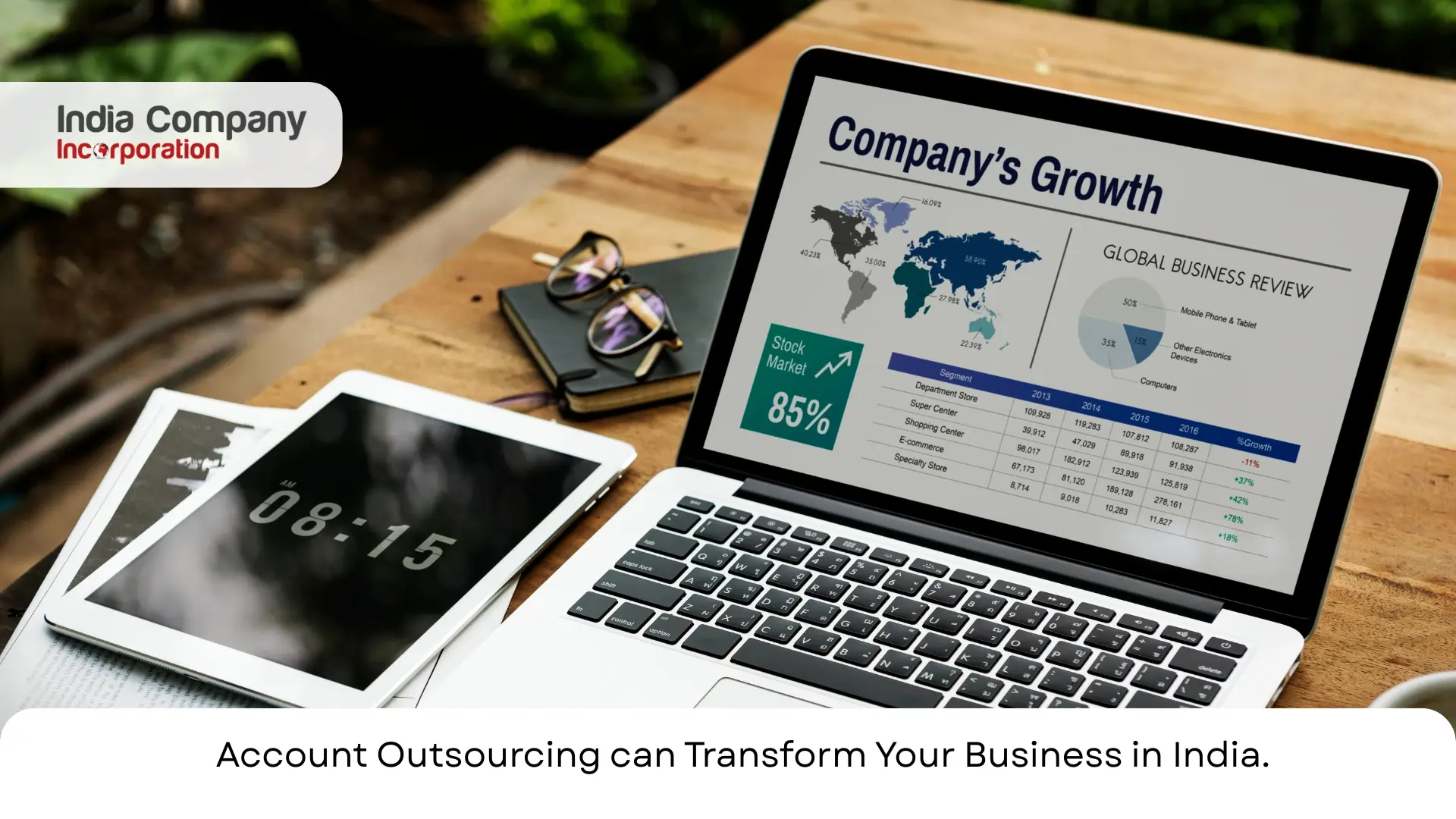
The current economic climate presents a range of structural and operational challenges for Small and Medium Enterprises (SMEs). Finance management is one of the most crucial things for making sure your business succeeds. SMEs have to be involved in a range of activities like keeping their customers happy, staying better than the competitors, and doing all the day-to-day operations. Consequently, they have little time left to focus on bookkeeping, financial analysis, and statutory compliance. That is where Account Outsourcing comes into the scenario. It is not just about saving money but it is a smart move that can help you control your finances better without having to worry about all the complicated accounting tasks. Let us understand how outsourcing your Accounting work to experts can change the way you run your business and make operations easier. Regulatory Requirements for Account Outsourcing: Following are the provisions under different laws requiring the maintenance of books of accounts by entities carrying of a business or profession: Section 128(1) of the Companies Act, 2013 requires every company to prepare and keep the books of account and other relevant books at its registered office. Section 44AA of the Income-tax Act, 1961, mandates the maintenance of books of account by certain persons engaged in specified professions and businesses. It provides for the preparation and maintenance of books of account by a person if his income or gross turnover or receipts, as the case may be, exceeds the prescribed threshold limit. Section 36 of the CGST Act, 2017 requires every registered person to keep and maintain the account books and records for at least 72 months (6 years) from the due date of furnishing of annual return for the year pertaining to such accounts and records. Section 34 of the LLP Act, 2008 requires limited liability partnership to maintain proper books of account as may be prescribed relating to its affairs for each year of its existence on a cash basis or accrual basis and according to double entry system of accounting and shall maintain the same at its registered office for such period as may be prescribed. Thus, all types of entities, irrespective of their form, have to mandatorily maintain their books of accounts as per the provisions of the applicable Laws. Why Should You Outsource Your Accounts? Outsourcing accounting does not mean handing over responsibilities, but it is more of bringing in expertise, efficiency, and professionalism in the accounts department and giving yourself more bandwidth for expanding business. There are numerous reasons why accounts should be outsourced. Here is why it is worth considering: Save cost and time Related Read: Enhancing Tenant Relations and Lease Management with Yardi Voyager Small and Medium-sized enterprises often face challenges in maintaining an efficient in-house accounting team. Limited resources and expertise make handling complex financial tasks difficult. A major challenge is continuously training and retaining qualified employees. Maintaining an in-house accounts team is quite expensive. You have to pay for hiring costs, salaries, employee benefits, perks, training, and statutory compliance. Apart from this consider the cost of providing office space, and software subscriptions. Outdated accounting systems further complicate financial management. Without updated knowledge and the latest technological tools, managing accounts may lead to inefficiencies and inaccuracies. In contrast, the account outsourcing model provides you a cost-effective solution. By outsourcing accounting functions, you can eliminate these overheads and get access to skilled and experienced professionals at a relatively lower cost. You get better results for lesser cost and extra hours for your business growth and expansion. It ensures cost savings, expertise, timely statutory compliances, and access to the latest tools without the burden of an in-House team. Access to experts who understand compliance Account outsourcing is a strategic approach that helps businesses in improving financial efficiency and regulatory compliance. Navigating the complex tax laws, tax filings and compliance requirements is a daunting task and very time-consuming process. These laws are constantly changing and one needs to be always updated with the latest regulations, amendments, and reforms. This represents a full-time job. The consequence of any non-compliance can be severe and can attract interest and penalties. These compliance risks can be managed well with the help of Account outsourcing. Outsourcing ensures that your accounts are always managed by experts who know the rules and the latest changes. These ensure you never miss deadlines and avoid paying penalties. By outsourcing to a specialized firm, organizations can stay updated on evolving regulations with minimum financial management risks. More focus on growing your business As a business owner, your time is valuable. It is essential to prioritize activities that can drive growth, innovation, and customer satisfaction. Rather than getting buried in the umpteen spreadsheets, it is better to have more time to focus on better customer relations, develop new products, and expand new markets. Account Outsourcing allows you to free up your time and resources and helps you channel your energy to what you do best i.e. driving business success and growth of your business. This leaves the accounting part with professionals who have the requisite expertise and bandwidth to do the job. Flexibility As your business grows, your accounting requirements become more and more complex. As your company’s financial landscape undergoes significant changes, more sophisticated financial management and accounting expertise is needed. Whether you are a startup with basic bookkeeping requirements or an established SME navigating cashflow challenges, Account outsourcing offers scalability and flexibility tailored to your current stage of growth. With Account outsourcing, you can easily adapt to changing accounting requirements ensuring your accounting is aligned with your evolving business needs. Leverage technology Professional Accountants leverage the benefits of using the latest technologies in streamlining your accounting with enhanced accuracy and providing actionable insights. They use cutting-edge technology to automate various routine and repetitive tasks, reduce errors, and generate productive reports. This means that by outsourcing accounts, you gain access to the latest software and tools without any real investment in them. How Can We Help You Succeed? At the heart … Read more


Setting up Business in GIFT City – Eligibility and Benefits

Gujarat International Finance Tech-City (GIFT City) is India’s emerging international financial hub, situated in Gandhinagar between Ahmedabad and the state capital. Designed as a global financial centre, it manages international financial transactions outside domestic jurisdiction in India. Regulated by the International Financial Services Centres Authority, the zone offers strong regulatory support and tax incentives. The government recently allowed individuals to open foreign currency bank accounts in GIFT City. With advanced infrastructure and favourable policies, the financial hub aims to compete with global centres such as Singapore and Dubai while attracting international investors and businesses. Reasons to Choose GIFT City for Business Setup Gujarat International Finance Tec-City has rapidly emerged as one of India’s most promising destinations for global businesses and financial institutions. Its progressive regulatory framework, attractive tax incentives, and world-class infrastructure create an ecosystem designed to support international commerce. These advantages make GIFT City an appealing location for organisations seeking efficient market access and long-term growth opportunities in India. Internationally benchmarked regulatory environment Gujarat International Finance Tec-City operates under a globally aligned regulatory framework supervised by the International Financial Services Centres Authority. This structure simplifies compliance while maintaining high international standards. Businesses benefit from transparent governance and streamlined regulatory procedures that reduce administrative complexity. Tax incentives Recognised as a Special Economic Zone under the Special Economic Zones Act 2005, GIFT City offers substantial fiscal advantages to businesses. Companies operating within the zone can access various tax incentives designed to enhance investment efficiency. These benefits significantly reduce the overall tax burden and support stronger long-term returns. Ease of doing business The policy ecosystem within GIFT City prioritises operational efficiency and investor convenience. Simplified procedures, supportive regulatory bodies, and clear compliance guidelines enable businesses to establish and operate with minimal friction. This environment allows organisations to focus on growth and innovation rather than administrative hurdles. State-of-the-artinfrastructure Established in 2015, GIFT City was developed with advanced technology and modern urban planning at its core. The financial hub features premium office spaces, high-speed digital connectivity, and world-class utilities. Such infrastructure supports financial institutions and global businesses seeking a sophisticated operational base. Strategic location Situated in Gandhinagar and positioned between Ahmedabad and the state capital, GIFT City follows a well-planned tri-city development approach. This location ensures strong connectivity and easy accessibility for businesses and professionals. The strategic positioning enhances its potential as a dynamic financial and commercial hub in India. Tax Benefits for Setting up Business in GIFT City Gujarat International Finance Tec-City offers a highly competitive tax framework designed to attract global businesses and financial institutions. The regulatory structure under the International Financial Services Centres Authority provides multiple fiscal incentives that reduce operational costs and improve investment returns. These advantages make GIFT City an attractive destination for companies seeking tax efficiency while expanding their presence in India. It is also an ideal location for organisations planning Company Registration consultant in india while gaining access to global financial markets. Income Tax Benefits Fund managers operating within GIFT City can claim a 100% income tax exemption for ten consecutive years within a fifteen-year period. During this time, profits earned from fund management activities remain exempt from taxation, which supports early-stage growth and capital accumulation. If the Minimum Alternate Tax (MAT) becomes applicable, companies may still benefit from a reduced MAT rate under Section 115JB of the Income Tax Act. These provisions generally apply to profits generated through Special Economic Zone operations. GST and Custom Duties As GIFT City operates as a Special Economic Zone under the Special Economic Zones Act 2005, goods and services supplied to locations outside the SEZ qualify as exports and attract a 0% GST rate. Transactions conducted within the GIFT ecosystem are also treated as zero-rated supplies, which removes the burden of GST for many internal operations. Imports into the zone follow standard customs regulations. However, when such imports are later exported outside the SEZ, they are treated as zero-rated supplies and no GST is levied on these components. Businesses established in GIFT City can also utilise warehousing facilities that allow customs duty deferment or exemptions until the goods enter the domestic market. Particulars  Units in IFSC  Income Tax  100% tax exemption for 10 consecutive years out of 15 years MAT/AMT at 9% of book profits applies to company/other setups as a unit in IFSC. MAT not applicable to companies in IFSC opting for the new tax regime From April 01, 2020, dividend income distributed by company in IFSC will be taxed by the shareholder Goods & Services Tax  No GST on services received by units in IFSC No GST on services provided to IFSC/SEZ units or offshore clients GST applicable on services provided to DTA Other Taxes Duties  State subsidies including lease rental, PF contribution, and electricity charges Special Economic Zone (SEZ) Advantages A Special Economic Zone is a designated region within a country that enjoys relaxed financial and regulatory policies compared to the domestic economy. Such zones are created to attract global businesses, increase foreign investment, and stimulate economic development. For a rapidly developing economy such as India, SEZs play a critical role in strengthening global trade and investment flows. Establishing operations in Gujarat International Finance Tec-City allows businesses to fully leverage these SEZ advantages. Companies operating within the zone benefit from duty-free import and export of goods and services, along with a regulatory environment designed to support international finance. However, the advantages of GIFT City extend beyond tax benefits alone. Unlike many SEZs in India that focus primarily on manufacturing, GIFT City is specifically designed for financial services and related sectors. Its strategic location and strong regulatory integration enable seamless connectivity with global financial markets, positioning it as a unique international financial hub within India. Regulatory Framework and Compliance in GIFT City International Financial Services Centres Authority (IFSCA) functions as the unified regulator governing all financial activities within Gujarat International Finance Tec-City. Established in 2020 and headquartered in Gandhinagar, IFSCA oversees the development and regulation of financial products, institutions, and services within India’s International Financial Services Centres. At present, GIFT City remains the only operational IFSC in India. Prior to the formation of IFSCA, regulatory oversight was shared among multiple authorities such as the Reserve Bank of India, Securities and Exchange Board of India, Pension Fund Regulatory and Development Authority, and Insurance Regulatory and Development Authority of India. Because financial services within an IFSC are closely interconnected, the … Read more

Ease of Doing Business in India – Key Updates 2025

Ease of doing business in India

India’s business environment is undergoing a remarkable transformation. Strategic policy shifts, regulatory simplification, and digital-first initiatives are transforming the way companies operate. Whether it’s global tech giants or homegrown exporters, these updates impact a broad spectrum of stakeholders. As 2025 unfolds, here’s a closer look at the reforms shaping a more agile and competitive India incorporation process. India – Ease of Doing Business Ranking India has emerged as one of the most attractive destinations for both investment and business operations. Since 2014, the Government of India has implemented an ambitious programme of regulatory reforms aimed at simplifying business procedures and creating a more business-friendly environment. These reforms have significantly enhanced India’s global competitiveness and ease of doing business. The results are evident in the country’s remarkable rise in international rankings over the past few years. Among 190 countries evaluated in the World Bank’s Doing Business 2020 report, India ranked 63rd. This marks an impressive jump of 79 positions from 142nd in 2014, reflecting sustained efforts to streamline processes and encourage entrepreneurship. Key Achievements Construction Permits: India’s ranking improved dramatically from 184 in 2014 to 27 in 2019, largely due to a reduction in procedures and the time required to obtain construction permits. Getting Electricity: India rose from 137th in 2014 to 22nd in 2019. Businesses now need just 53 days and four procedures to obtain an electricity connection. Protecting Minority Investors: India ranks 13th among 190 economies, demonstrating strong governance and investor protection. Getting Credit: The country ranks 25th, reflecting improved access to credit for businesses. These improvements highlight India’s commitment to fostering a transparent, efficient, and investor-friendly business environment, making it an increasingly favourable destination for global enterprises. Equalisation Levy on Online Ads to Be Abolished from April 2025 In a significant policy reversal, the Indian government has proposed scraping the 6% Equalisation Levy (EL) on online advertisements. The move is expected to benefit global digital companies and streamline tax compliance. The Equalisation Levy, introduced in 2016, applied to non-resident advertising service providers without a physical presence in India. It was levied when payments to these providers exceeded ₹1,00,000 annually. Proposed Change: The levy will be abolished effective April 1, 2025. This will directly benefit companies like Google, Meta, and Amazon, which dominate the global digital advertising market. Impact on Agencies: Larger agencies serving global clients may benefit from reduced costs and increased efficiency. However, smaller, domestically focused firms may face tougher competition from international players. Administrative Relief: The change reduces quarterly compliance burdens and documentation. Industry players have welcomed it as a step toward simplified taxation. This reform aligns with India’s broader strategy to promote cross-border trade and digital cooperation with key global partners, particularly the United States. MCA V3 Portal: A Digital Leap in Corporate Filing The Ministry of Corporate Affairs (MCA) will roll out the final batch of 38 forms on the MCA V3 portal by July 14, 2025. This upgrade will bring India closer to fully digitised, transparent corporate compliance. The new portal reflects the government’s commitment to reducing friction in business processes and increasing efficiency in governance. Web-Based Forms: Manual uploads are being replaced with streamlined web forms, which reduce redundancy and standardise data capture. Pre-Filled Fields: Automatic field population improves consistency and reduces manual errors, speeding up the overall filing process. File Handling & Linked Reports: Larger uploads (up to 10 MB per form) are now accepted. Linked filings allow for seamless submission of related documents. Other updates bring further enhancements to compliance and usability. Expanded Attachments: Shareholder files can now be uploaded up to 300 MB for MGT-7, accommodating more complex submissions. Visual Documentation: MGT filings will now require interior and exterior photos of office premises. This adds an extra layer of verification. Complaint Integration: The ICP and SCP complaint forms are merged into a single non-STP form, simplifying grievance reporting. CSR Updates: CSR-1 has been redesigned with enhanced local data fields. CSR-2 remains an online-only form. AGM Defaults: GNL-1 now includes fields for AGM-related defaults and compounding disclosures. This provides deeper regulatory visibility. The V3 portal is a decisive step toward real-time compliance and paperless governance. Businesses can expect greater clarity, faster turnarounds, and fewer regulatory hurdles. RoDTEP Benefits Reinstated for Exporters from June 2025 India has reinstated the RoDTEP scheme for exporters starting June 1, 2025. This move aims to improve India’s global trade competitiveness and ease the burden of unrecovered embedded taxes. The policy brings relief to various exporting industries and supports long-term trade growth. Wider Eligibility: Exporters under Advance Authorisation, EOUs, and SEZs now qualify for RoDTEP. This expands the benefit base significantly. Financial Commitment: ₹182.33 billion (US$2.13 billion) has been allocated for FY 2025–26, covering multiple product categories. Sectoral Coverage: Industries like textiles, chemicals, pharma, agriculture, and automobiles are eligible. Refunds are granted via transferable e-scrips. Application Process: Exporters must declare their RoDTEP claim while filing shipping bills. Credits are transferred post-export through the ICEGATE portal. Industry stakeholders have welcomed this move, but caution that consistency in policy is critical. Frequent changes can dilute exporter confidence and affect long-term competitiveness. The reintroduction of RoDTEP for SEZs and EOUs marks a strong shift toward making Indian exports more viable globally. India May Open Government Procurement to Foreign Companies The Indian government is considering opening its central procurement market to foreign firms. This proposal comes amid ongoing trade discussions with the United States. The move could attract more investment and competition in public projects. Expanded Access: Foreign companies may bid for federal procurement contracts. However, state and local contracts will remain closed to overseas firms. Trade Precedent: A similar provision was introduced in India’s recent FTA with the UK. British firms gained limited access to central procurement. MSME Safeguard: Despite reduced barriers to entry, 25% of public procurement will still be reserved for small Indian enterprises. This protects domestic industry interests. If implemented, this change could improve transparency and efficiency in public procurement. However, it also raises concerns among MSMEs about increased competition from global players. India’s balancing … Read more

Company and LLP Registration Online – How to Register & Incorporate a Company and LLP in India

Setup your business services with - india company incorporation

India offers significant opportunities for global businesses and investors. If you are considering entering the Indian market, registering an entity is a critical first step. Over the years, the registration procedure has been streamlined to promote ease of doing business, with LLP company registration online becoming increasingly popular among entrepreneurs. Let us walk you through the complete LLP registration process for two key business entities in India. It covers everything from choosing the right business structure to the specific steps required to register a company or LLP. Quick Summary: Steps for Company and LLP Registration Process in India Step Description Step 1 Choose the right business entity (, LLP, Pvt Ltd, etc.) Step 2 Reserve business name and file incorporation application (SPICe+ or FiLLiP) Step 3 Obtain PAN and TAN from the Income Tax Department Step 4 Open a company bank account and bring in initial capital Step 5 Register for GST and other licenses as required (Shops Act, EPF, etc.) Complete Steps In the Formation Of An LLP Company Company formation in India involves several critical steps, starting with selecting the appropriate business entity that aligns with your goals. Listed below are the step-by-step procedures for LLP company formation in India. Step 1: Choose the Right Business Entity in India Selecting an appropriate business entity is the foundational step when registering a company in India. It determines your legal status, compliance obligations, investment options, and liability. India offers several top business entities, each with its own features and suitability for different situations. Step 2: Fulfill Key Requirements (Documents Required For Company Registration, Digital Signatures, etc.) Once you have chosen the business structure, prepare the necessary prerequisites to register the entity officially: Name Reservation: Decide on a unique name for your business. Company names must adhere to the Companies Act rules – a proposed name should not infringe on trademarks and typically must include a word relevant to the business, plus a suffix indicating the entity type. You can check name availability on the MCA portal and through trademark databases. You must decide on a name relevant to your business with a suffix that indicates the entity type. It’s wise to have a few alternatives if your first choice is rejected. You can reserve the name for companies by filing Part A of the SPICe+ form online. Digital Signature Certificates (DSC): Since almost all registration filings in India are online, you will need digital signatures for the key people involved, specifically for all proposed directors of a company or designated partners. Director Identification Number (DIN): A DIN is a unique ID number for individuals who serve as directors on an Indian company’s board. If you are incorporating a new company, you don’t need to apply for a DIN separately. It is now auto-allotted as part of the company registration (SPICe+) process. In the incorporation form, you must provide the required personal details and proof of identity. Step 3: Lodging the Incorporation Documents with Government Departments Once you have prepared all the necessary documents and gathered the prerequisites, you must submit the incorporation documents to the relevant government departments for approval. This is a crucial step in the company registration process in India. Submitting the Incorporation Documents For Private Limited Companies, the incorporation documents must be submitted through the Ministry of Corporate Affairs (MCA) portal. The appropriate form filings for LLP Incorporation in India include the following: Director Identification Number (DIN) and Digital Signature Certificate (DSC) for the proposed directors: – DIN is required for individuals who will serve as directors on the company’s board. It’s now auto-allotted as part of the registration process through the SPICe+ form. – All the proposed directors must obtain a Class 3 DSC to digitally sign and submit the application forms online. Name Reservation: – Choose a unique company name that complies with the Companies Act regulations. You can check name availability on the MCA portal and trademark databases. – Name reservation is handled through Part A of the SPICe+ form. Memorandum of Association (MOA) and Articles of Association (AOA): – These documents outline the company’s scope of business and the rules governing its operation. They must be filed along with the incorporation documents. Proof of Registered Office Address: – You will also need to provide proof of the registered office address where the business will be conducted. This could be a utility bill or a rent agreement. Other Documents (if applicable): – You may be required to submit additional documents depending on the nature of your business and the type of entity. For example, foreign entities may need to submit proof of compliance with Foreign Direct Investment (FDI) regulations and approvals from the Reserve Bank of India (RBI). Filing the Forms Once all documents are prepared, you must file the required SPICe+ (for companies) or FiLLiP for LLPs) form online via the MCA portal. Step 4: Obtain Permanent Account Number (PAN) and Tax Account Number (TAN) After incorporation, you must secure the following: Permanent Account Number (PAN): Mandatory for all businesses in India. Tax Deduction and Collection Account Number (TAN): Required for businesses that deduct tax at source (TDS). For Private Limited Companies, both PAN and TAN are issued along with the certificate of incorporation. For other business entities, PAN must be applied for through the Income Tax Department, while TAN should be applied for separately if your business is subject to TDS. Step 5: Open a Bank Account and Bring in Capital Open a Bank Account and Inject/ Infuse Capital. After receiving the certificate of incorporation and PAN, you should: – Open a Current Account in the company’s name for business transactions. – Deposit the Initial Capital as agreed upon for shareholding into the company’s bank account. – If your business involves foreign investment, report the FDI to the RBI. You must submit the FC-GPR form within 30 days of share allotment. Step 6: Register for GST and Other Business Licenses GST Registration: is required if your annual turnover exceeds the prescribed … Read more

Form to Download PDF

Contact us

New Service form