Maharashtra: India’s Gateway for Business and Investment
Maharashtra: India’s Gateway for Business and Investment
In India’s rapidly evolving economic landscape, Maharashtra stands out as a premier destination for businesses seeking to scale, achieve stability, and foster long-term growth. With a population of 126.4 million, accounting for 9.1% of India’s population, the state offers one of the country’s largest and most diverse consumer markets. Its urbanisation level of 48.5%, significantly higher than the national average, ensures a steady supply of skilled labour, robust consumption demand, and strong market depth. Favourable demographic indicators further strengthenMaharashtra’s investment appeal.
Mumbai, the state capital, is India’s financial nerve centre and home to the Bombay Stock Exchange (BSE) and the National Stock Exchange (NSE), where the majority of the country’s secondary market transactions take place. Supported by strong economic fundamentals, sectoral diversity, investor-friendly policies, and a mature industrial ecosystem, Maharashtra offers a compelling value proposition for domestic and global investors. Its combination of scale, governance stability, and forward-looking reforms positions it as a strategic gateway to India’s broader growth story.
Economic Performance & Growth Indicators
The state’s Gross State Domestic Product (GSDP) is estimated at ₹49.39 trillion (US$578.31 billion) in FY26, recording a Cumulative Annual Growth Rate (CAGR) of 10.78% in US dollar terms between FY16 and FY26. To sustain this momentum, the Government of Maharashtra has committed approximately US$50.6 billion towards growth-oriented investments across infrastructure, industry, and logistics. The state hosts over 10.31 lakh registered MSMEs, forming a strong backbone for manufacturing and services, complemented by a vibrant start-u2p ecosystem particularly in Mumbai, which supports 9,000+ active start-ups across fintech, IT, and digital services.
Maharashtra’s economy is highly diversified, with services contributing around 59% of Gross State Value Added (GSVA), out of which the industrial sector contributes 27.4%, while agriculture and allied activities like animal husbandry, Horticulture, Sericulture, etc. contribute 13.6%, ensuring stability, resilience, and multiple investment entry points across sectors.
Reinforcing this strength, Maharashtra is India’s largest recipient of Foreign Direct Investment (FDI), having attracted ₹7.43 lakh crore (US$94.04 billion) between April 2000 and June 2025, representing 31% of India’s total FDI inflows. Sector-specific infrastructure, a pro-business environment, and access to India’s most employable workforce (70%) continue to drive Maharashtra’s FDI leadership.
Industrial Landscape & Manufacturing
Automobile
India’s automotive value chain finds one of its strongest bases in the state, supported by a mature ecosystem comprising leading Original Equipment Manufacturers (OEMs), a deep auto-component supplier network, skilled manpower, and robust industrial infrastructure. Pune functions as the primary automotive hub, hosting over 4,000 units in the Pimpri-Chinchwad belt, while the broader state ecosystem includes more than 10,000 auto and auto-component units. Major manufacturers such as Bajaj Auto, Tata Motors, and Daimler Chrysler operate alongside established tier-1 and tier-2 suppliers, with Nashik adding scale through Mahindra & Mahindra’s manufacturing facility. The region is also gaining prominence as an electric mobility destination, with EV and battery investments of
₹8,420 crore, supported by a comprehensive EV policy and fiscal incentives.
Textile
Maharashtra is a leading textile and apparel manufacturing hub, supported by strong raw material availability and consistent policy backing. The state contributes about 10.4% of India’s total textiles and apparel output and nearly 25% of national cotton production, providing a natural advantage for integrated and value-added textile manufacturing. The sector is a major employment generator and contributes around 28% to India’s total exports.
Investor confidence remains strong, highlighted by the October 2024 MoU with OFB Tech Pvt. Ltd. involving an investment of US$89.3 million in Wardha district. To enhance competitiveness, Maharashtra is developing dedicated textile parks in Dhule, Nagpur, and Ambernath, offering plug-and-play infrastructure and logistics proximity. Backed by a textile policy targeting ₹36,000 crore (US$5.6 billion) in investments, the sector offers scalable, export-oriented opportunities.
Pharmaceuticals
A dominant position in India’s pharmaceutical landscape is driven by scale, regulatory credibility, and export orientation. The sector accounts for 14% of domestic pharmaceutical production, 11% of the Indian pharma market, and 20% of national pharma exports, supported by more than 3,800 manufacturing units across Mumbai–Thane,Pune, Nashik, Aurangabad, and Nagpur.
The presence of the highest number of US FDA-approved (59) and EU-approved (47) facilities, along with 468 WHO-GMP certified units, ensures global compliance standards. Policy support through PSI 2019, SGST reimbursements, and stamp duty exemptions enhances ease of doing business.Significant opportunities exist across Contract Research and Manufacturing Services (CRAMS), Active Pharmaceutical Ingredient (API), biosimilars, and medical devices, positioning the ecosystem as a globally integrated life sciences hub.
IT/ITES
Maharashtra is one of India’s leading IT and ITES hubs, contributing 19% (approximately US$40 billion) to India’s IT industry and 20% of national IT exports. The sector generates nearly US$35 billion, contributing around 9% to the state’s Gross Value Added (GVA).
The ecosystem includes 1,200+ software units, 577 approved IT parks, and 37 public IT parks. Mumbai and Pune together host nearly 20% of India’s Global Capability Centres (GCCs), while the state accounts for 65% of India’s datacentre capacity, making Mumbai India’s data centre hub. Progressive policies such as the IT Policy 2023 and PSI 2019 offer capital subsidies and operational incentives, driving growth in cloud computing, data centres, fintech,Animation, Visual Effects, Gaming, and Comics (AVGC), and emerging technologies.
Agriculture and Rural Economy
A diversified agricultural base supports strong investment opportunities across farming and allied activities.Production spans cotton, sugarcane, soyabean, pulses, horticulture crops, and organic produce, reducing dependency risks and enabling year-round operations. Market efficiency and price discovery are strengthened through an extensive network of APMCs, e-NAM markets, cold storage facilities, and pack houses. Productivity gains are driven by the adoption of micro-irrigation, solar pumps, improved seed varieties, and digital agri-advisory platforms, while schemes such as Rashtriya Krishi Vikas Yojana (RKVY), Pradhan Mantri Krishi Sinchayee Yojana (PMKSY) Pradhan Mantri Kisan Urja Suraksha evam Utthaan Mahabhiyan (PM-KUSUM), and crop insurance mitigate investor risk. Supported by a large agriculture-based workforce and well-established export infrastructure, the state offers scalable investment opportunities across food processing, agri-logistics, farm mechanisation, and export-focused agribusiness
Infrastructure Development and Investment
Sustained investments in physical and digital infrastructure have significantly enhanced the state’s attractiveness for investors. Connectivity is supported by an extensive network of national and state highways, high-speed corridors such as the Mumbai–Pune Expressway, expanding metro and rail systems, and multiple domestic and international airports. The upcoming Navi Mumbai International Airport is expected to substantially increase cargo and passenger handling capacity. Port-led development remains a key strength, backed by a 720-km coastline, JNPT—India’s largest container port, and Sagarmala-driven port expansion. With 14,400 MW of installed power capacity, the state is India’s second-largest power producer, offering reliable supply through a diversified and growing renewable mix. Strong digital connectivity, eight Smart Cities, and robust water and irrigation infrastructure further reinforce long-term industrial sustainability.
City Hotspots
Nagpur
Driven by manufacturing, logistics, mining, and agro-based industries, the city has emerged as a high-potential investment destination supported by a large and diversified industrial base. Its ecosystem is anchored by Asia’s largest industrial area at Butibori, housing major units such as Indo Rama Synthetics, KEC, Hyundai Unitech, and nearby thermal power facilities, alongside the Hingna industrial estate, which accommodates around 900 small and medium enterprises, including Mahindra & Mahindra, NECO Ltd., Bajaj Auto Group, and Candico. The region’s industrial depth is further sustained by the presence of large public and private enterprises such as WCL, MOIL, Ordnance Factory, Reliance Polyesters, VIP Industries, and Sunflag Iron & Steel, underscoring its strong corporate presence and manufacturing scale.
Nagpur benefits from its “Zero Mile” logistics advantage due to its strategic geographic location and the CONCOR Inland Container Depot, linking the city efficiently with both domestic and international markets via major rail and highway corridors. This connectivity supports urban commercial hubs like Sitabuldi and Kalamna markets, boosting urbanisation and consumer demand. Investor-oriented infrastructure, such as the MIHAN cargo hub and SEZ, enhances export-oriented growth and strengthens Nagpur’s appeal as a logistics, manufacturing, and trade gateway. With a strong industrial base, connectivity, and an established corporate presence, Nagpur offers compelling opportunities across manufacturing, logistics, and export-driven sectors.
Pune
Pune is a leading automobile and auto-components hub along with IT and ITES centre, supported by dedicated IT parks and SEZs. The scale of industrial activity is substantial, with over 2.34 lakh MSMEs and nearly 700 large units, together accounting for investments exceeding ₹1,09,66,797 lakh and generating employment for nearly 2 million people. Pune’s strategic location and strong connectivity via national highways, a dense rail network, and an international airport at Lohegaon position it as a key logistics and trade hub with access to both domestic and international markets. Rapid urbanisation, high literacy levels, and the presence of two municipal corporations have created robust consumer demand and a large skilled workforce. State-led industrial development through MIDC industrial areas such as Pimpri-Chinchwad, Chakan, Talegaon, Ranjangaon, Baramati, and Kurkumbh, along with SEZs like Khed SEZ and Rajiv Gandhi Infotech Park, reflects strong sector-specific policy support. The presence of large corporates and MNCs across manufacturing, IT, pharma, and finance further strengthens Pune’s investment ecosystem, while proposed logistics parks, rail upgrades, and airport expansion enhance its long-term industrial and export potential.
Mumbai
Mumbai’s economy is dominated by financial services, banking, capital markets, insurance, and corporate headquarters. It is also India’s hub for media, entertainment, advertising, real estate, and professional services, while its ports support international trade, shipping, and logistics. It is one of India’s most powerful economic centres, underpinned by a large and diversified industrial and services base that contributes about 6.16% of India’s GDP, nearly 25% of national industrial output, and accounts for around 70% of India’s maritime trade and capital transactions. The district hosts over 7,000 MSMEs along with numerous large industrial units across engineering products, chemicals, textiles and garments, pharmaceuticals, electronics, petrochemicals, leather goods, gems and jewellery, and automobiles, while its dominant service sectors include financial services, IT and ITeS, media and entertainment, healthcare, logistics, real estate, and professional services.
Mumbai’s strategic coastal location along the Arabian Sea, supported by Mumbai Port Trust, JNPT, ICDs, an international airport, national highways, and an extensive rail network, provides seamless access to domestic and global markets, reinforcing its role as India’s primary trade gateway. High urbanisation and population density generate sustained consumer demand, supported by a vast banking and financial network. State-supported industrial and sectoral development through MIDC estates, Santacruz Electronics Export Processing Zone (SEEPZ), port-led logistics infrastructure, and transport connectivity projects strengthens the business ecosystem. The presence of major Indian corporates and MNCs such as Tata Group, Reliance Industries, and Aditya Birla Group, along with institutions like RBI, BSE, NSE, and SEBI, underscores Mumbai’s strengths as India’s financial capital, offering significant opportunities in global finance, trade, logistics, technology, real estate, and creative industries.
Trade and Commercial Activities
Maharashtra plays a pivotal role in India’s trade and global supply chains, supported by strong export performance and deep domestic market linkages. The state recorded exports of ₹5.07 lakh crore (US $59.34 billion) in FY25 (April–February), with engineering goods, gems and jewellery, pharmaceuticals, electronic goods and chemicals forming the backbone of its global market reach. Domestically, Maharashtra’s large and urbanised consumer base—anchored by Mumbai, Pune and Nagpur—drives sustained demand across manufacturing, services, retail and e-commerce, supported by high internet and wireless penetration exceeding 100 million subscribers. Inter-state trade connectivity is enabled by an extensive transport network of over 18,000 km of national highways, a well-developed rail system, and strong multimodal logistics integration. The presence of Jawaharlal Nehru Port, India’s largest container port, along with two major and 48 minor ports, positions the state as a critical logistics and export gateway. Maharashtra’s integration into global value chains is further strengthened by SEZs, industrial corridors, and growing e-commerce infrastructure, allowing efficient movement of goods across domestic and international markets and reinforcing its status as India’s leading trade, logistics and export-oriented investment destination.
Government Policies and Incentives
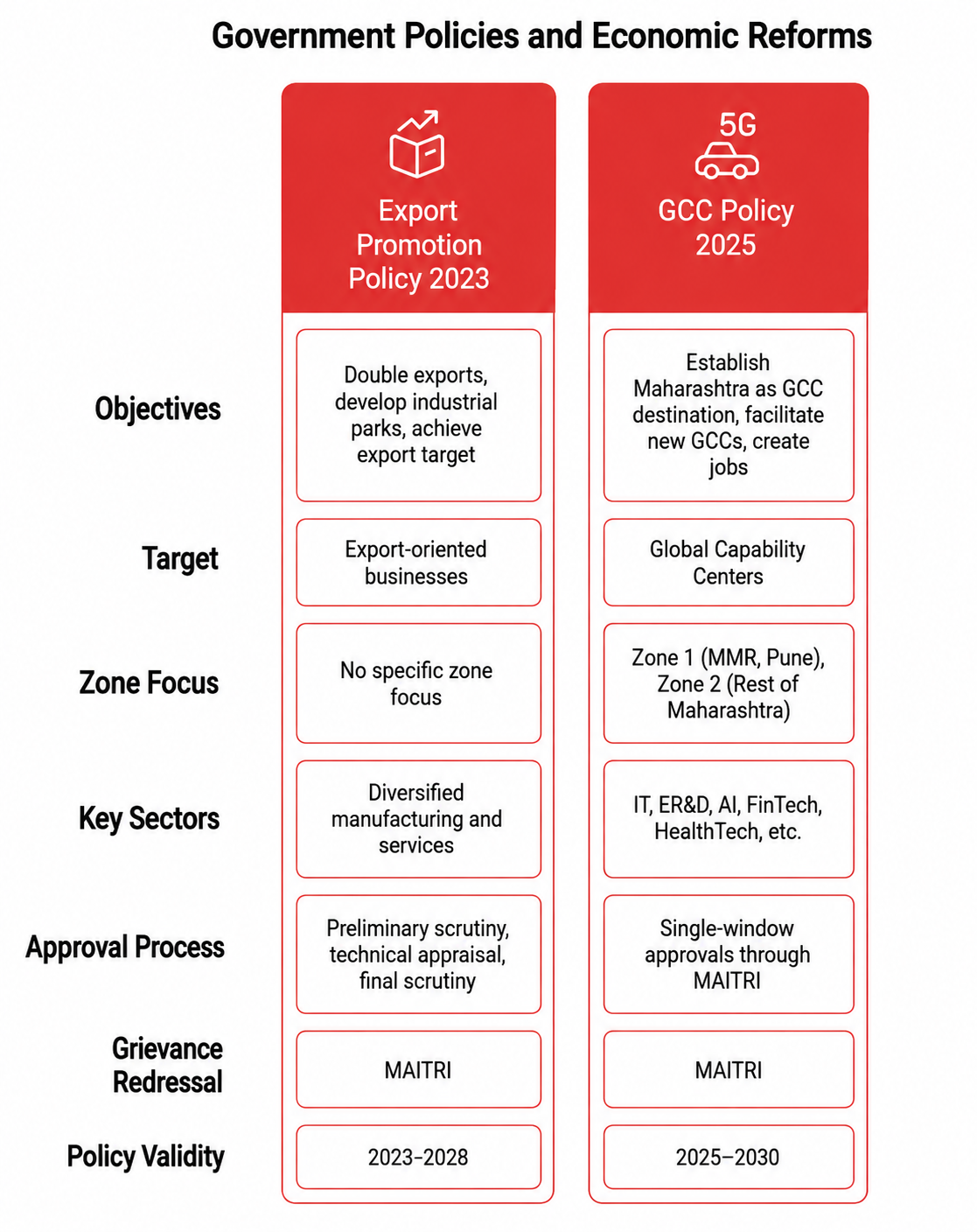
Indian State Governments offer varied incentives under their respective state industrial development corporation policies to promote the setup of new manufacturing units in the state. Such incentives are in the form of capital subsidies, interest subsidies, subsidised electricity tariffs, and more. The purpose of such incentive schemes is to attract investments, thereby enabling infrastructure development, generating employment, developing focus sectors, and largely facilitating the overall economic development of the state. Two of such policies are the Export Promotion policy 2023 and the GCC policy 2025.
Incentives
1) Maharashtra State Export Promotion Policy- 2023
a) Special Export Incentives for Manufacturing Sector
Financial Incentives for Export-Oriented MSMEs
Export-oriented MSMEs and FPOs registered in Maharashtra are eligible.
Incentives Available
Incremental Export Growth Subsidy
• 1% (outside EOIP) / 2% (within EOIP)
• Enhanced rates for agriculture & aqua units
• Applicable for 5 years
ECGC Premium Refund
• First 5 consignments (outside EOIP)
• First 10 consignments (within EOIP)
c) Interest Subsidy
• Up to 5% interest subsidy for eligible PLI-covered sectors
• Governed by SAP-2019 zoning provisions
Approvals are processed within 30 days, with grievances handled via MAITRI.
Key Eligibility
• MSME status as per the Government of India norms
• Minimum export turnover: 50% (30% for agriculture, aqua, women-led, SC/ST units)
b) Special Export Incentives for Special Large-Scale Industries (LSI)
Large manufacturing exporters exceeding MSME thresholds qualify as Special LSI.
Incentives Offered
• Electricity Duty Exemption (up to 7 years in EOIP)
• Employer’s PF/ESIC reimbursement
• Capital subsidy for technology upgradation
Key Eligibility
• Minimum investment up to INR 750 crore
• Minimum export turnover of 50%
c) Incentives for New Export-Oriented MSMEs
New exporters participating in:
• International exhibitions
• Trade fairs
• Buyer-seller meets
are eligible for cost reimbursement.
Financial Assistance
• 50% reimbursement (75% for women-led/SC-ST units)
• Maximum INR 3 lakh per event
• Eligible twice during the policy period
d) Service Export Promotion Incentives
The policy also supports service exporters, including:
• IT/ITES
• Professional services
• E-commerce exporters
Eligible Activities
• International trade exhibitions
• Cross-border e-commerce exports
• ODOP and GI-tagged product promotion
• Maharashtra International Trade Fairs
Financial assistance will be notified separately based on performance benchmarks.
Application Process
The application process of Maharashtra Export Promotion Policy 2023 involves getting your basic export registrations, understanding the specific incentive you qualify for (like ODOP or Awards), and applying through the official MAITRI/Directorate of Industries portals with detailed, certified documentation as per the scheme's timeline.
Incentives
2. Maharashtra Global Capability Centre (GCC) Policy – 2025
To enhance competitiveness, the policy offers a comprehensive incentive package:
Financial Incentives
- Capital investment-linked incentives
- Electricity duty exemption and power tariff subsidies
- Stamp duty concessions
- R&D Grants
- Internship Incentives
- Infrastructure and utility-related fiscal support
- Payroll Subsidy- for employees earning > ₹ 1,00,000 per month
- Zone I: 40% of salary component above ₹ 1Lakh
- Zone II: 50% of salary component above ₹ 1Lakh
- Additional 10% subsidy for 50%+ diversity hiring (women and PwD) capped at ₹ 5Cr per year, up to 100 employees.
- Rental Subsidy- If opting out of capital subsidy- Up to 5 yrs
- Zone I: 10% of actual Rent
- Zone II: 20% of actual Rent
Rent depends on the GCC classification, i.e. in case of small GCC- Up to 1crs; Medium GCC-Up to 2 crs; Large GCC-Up to 3 crs and Mega/Ultra GCC- Up to 4 crs.
Non-Financial Incentives
- Single-window approvals through MAITRI
- Ease of doing business reforms and fast-track clearances
- Recognition of GCCs as essential services, enabling flexible and 24×7 operations
- Support for digital repositories and regulatory facilitation
Eligibility
GCC units meeting the minimum threshold limits of Fixed Capital Investment (FCI) OR Direct Employment prescribed as given in Table below shall be eligible:
|
GCC Classification |
Investment Criteria |
No. of Employees Recruited |
|
Small |
₹50 crores - ₹100 crores |
100-250 |
|
Medium |
₹100 crores - ₹250 crores |
250-500 |
|
Large |
₹250 - ₹500 crores |
500-750 |
|
Mega |
₹500 - ₹750 crores |
750-1000 |
|
Ultra Mega |
>₹750 crores |
>1000 |
Provided that:
- a) Projects based on employment criteria shall be required to maintain the qualifying direct employment (on the roll and in the premises of the eligible Unit) throughout the year. If the employment criteria is not maintained in any month of the year for which the Incentive is claimed, then the incentive shall not be admissible for such year.
- b) Minimum Direct Employment prescribed in the table above should be created within a period of two years from the date of commencement of commercial production.
- c) In the case of an expansion or diversification project, the total investment in Plant & Machinery or Equipment, in the proposed expansion/diversification project, should fall within the limits specified above to qualify for incentives under the policy clause 3.4.4 ‘Incentives for Incremental Investment’.
Excluded Activities
- BPO Units
- Call Centres (Self or Third Party)
- Pure Sales, Marketing or Distribution entities.
Application Process
The application is submitted through MAITRI or the Directorate of Industries, and the respective agency routes it to all relevant departments, tracks approvals, and facilitates clearances, reducing delays and administrative burden.
Conclusion
Maharashtra’s position as India’s economic and financial powerhouse is underpinned by a rare combination of scale, sectoral diversity, infrastructure depth, and policy-driven ease of doing business. From Mumbai’s role as the country’s financial capital to Pune’s manufacturing and technology ecosystem and Nagpur’s emergence as a logistics and industrial hub, the state offers investors multiple entry points aligned with long-term growth, export orientation, and domestic market access.
For businesses seeking to establish or expand their presence in Maharashtra, a well-structured entry strategy and seamless regulatory execution are critical. India Company Incorporation supports foreign investors with end-to-end incorporation services in Maharashtra, covering entity structuring, company registration, regulatory approvals, and post-incorporation compliances. With on-ground expertise and a deep understanding of state-specific policies and incentives, we enable businesses to translate Maharashtra’s investment potential into a compliant, scalable, and operationally efficient presence in India.
In This Section
- Maharashtra: India’s Gateway for Business and Investment
- Economic Performance & Growth Indicators
- Industrial Landscape & Manufacturing
- Agriculture and Rural Economy
- Infrastructure Development and Investment
- City Hotspots
- Trade and Commercial Activities
- Government Policies and Incentives
- Incentives
- Conclusion