Where to Invest
Establishing a Company in India
India’s business environment has undergone a dramatic transformation in recent years, driven by a series of progressive economic reforms introduced by the national government. Key reforms include the implementation of the Goods and Services Tax, which unified and strengthened the indirect tax system, and liberalising FDI across multiple sectors, which has enhanced and improved the ease of doing business in India.
As a result, companies establishing a presence in India today benefit from being in one of the fastest-growing major economies in the world. India’s business environment offers a combination of strong domestic demand, a large and youthful workforce, competitive labour costs, and a range of government initiatives designed to promote manufacturing, innovation, and foreign investment. Together, these factors make India an increasingly attractive destination for businesses looking to expand their global footprint.
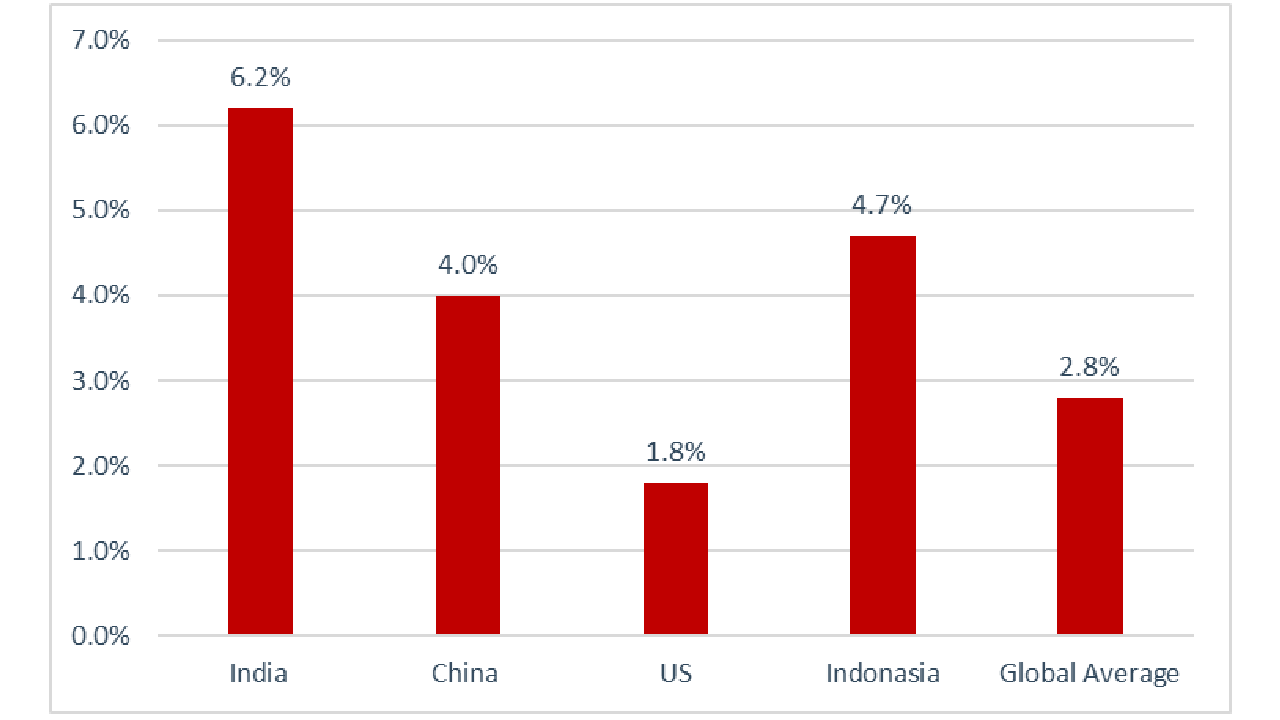
India recorded a robust real GDP growth of 6.2%, the highest among major global economies, underscoring its strong economic momentum. In comparison, China’s GDP grew by 4.0%. With a GDP of USD 4.19 trillion, the country is projected to sustain its growth trajectory, reaching an estimated USD 7.13 trillion by 2030.
Real gross domestic product (GDP) growth rate in 2025
India saw a 14% increase in Foreign Direct Investment (FDI) driven by the increased FDI in the service sector. This growth in FDI reflects growing investor confidence in India’s economic resilience, policy stability, and expanding domestic market. The 14% surge underscores India’s position as a preferred global investment destination, especially in sectors such as financial services, IT, e-commerce, and telecommunications that continue to attract sustained inflows.
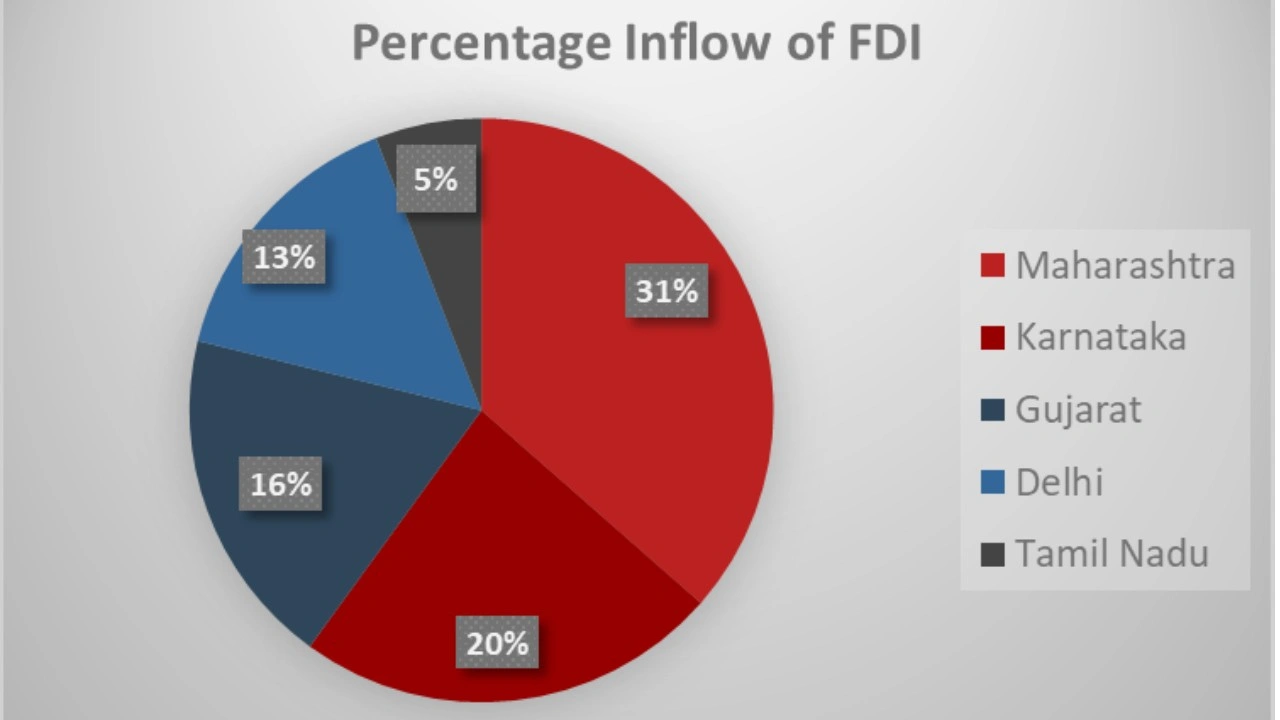
In terms of geographic distribution, the FDI inflows remain concentrated in key industrial and service hubs. Maharashtra continues to lead, accounting for 31% of total FDI inflows, supported by Mumbai’s position as India’s financial capital and its strong service-sector base. Karnataka follows with 21%, driven by Bengaluru’s dominance in IT, R&D, and technology-led services. Gujarat attracts 16%, largely due to its manufacturing and industrial infrastructure, while the National Capital Territory of Delhi secures 13%, reflecting its prominence in services, real estate, and trade. Tamil Nadu, with 5%, benefits from its diversified manufacturing and automobile ecosystem.
| Top Five Indian States with the Highest FDI Inflow from FY 2000-2025 | ||
|---|---|---|
| State | Cumulative FDI Inflow (in billion) | Percentage |
| Maharashtra | $ 88.7 | 31% |
| Karnataka | $ 57.6 | 20% |
| Gujarat | $ 44.5 | 16% |
| Delhi | $ 37.8 | 13% |
| Tamil Nadu | $ 14.6 | 5% |
India’s Developing Logistics Network
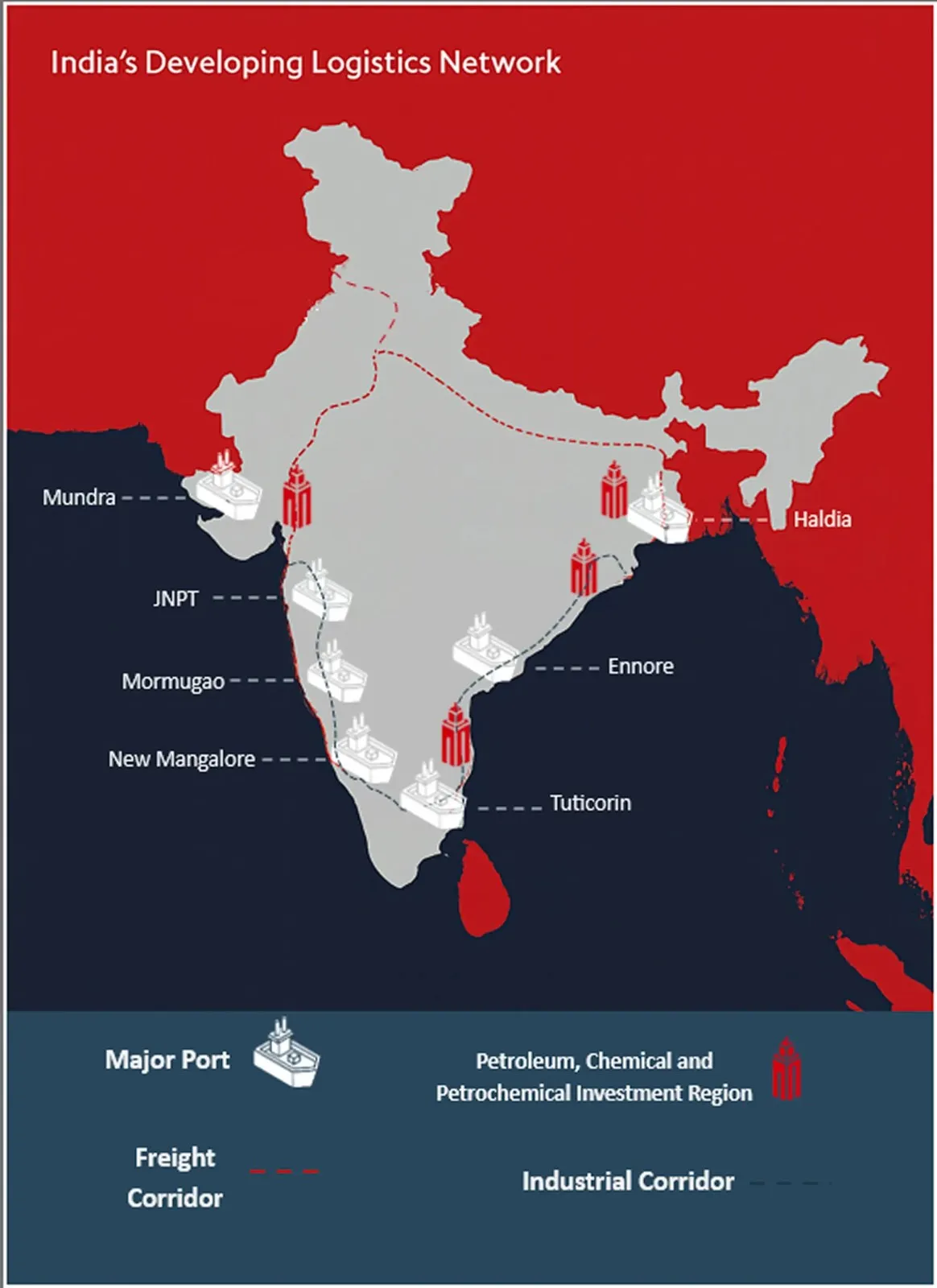
India’s logistics infrastructure is undergoing a transformative expansion, supported by strategic investments in ports, freight corridors, and industrial connectivity. Mundra Port in Gujarat, the country’s largest commercial port, serves as a critical gateway for trade, offering state-of-the-art facilities and integrated rail-road connectivity. On the western coast, Jawaharlal Nehru Port (JNPT) near Mumbai remains India’s premier container-handling port, facilitating efficient cargo movement across northern and central India. Complementing these developments, enhanced freight routes now link Gujarat’s industrial clusters with eastern ports such as Kolkata, strengthening the country’s east – west logistics backbone. Additionally, National Highway 53, which runs from Hajira in Gujarat to Paradeep in Odisha, forms part of an emerging industrial and transport corridor connecting western and eastern India. Together, these developments underscore India’s commitment to building a modern, multimodal logistics network that drives competitiveness, reduces transit times, and supports the nation’s broader manufacturing and export growth objectives.
Where to Invest in India
While India’s overall investment climate is highly conducive to business, the country’s true advantage lies in its regional diversity. Each state offers a distinct set of strengths, whether in terms of industrial infrastructure, availability of skilled talent, policy incentives, or ease of operations. As a result, identifying the right location becomes a strategic consideration aligned with a company’s industry, scale, and long-term objectives. The following section highlights some of India’s key states that stand out as attractive destinations for investment, along with the specific opportunities and regulatory benefits they offer.
1. India’s Leading Investment Destinations
A. Maharashtra: India’s Industrial and Innovation Powerhouse
Integrated Industrial Corridors and Port Connectivity
As India’s financial and industrial powerhouse, Maharashtra continues to be one of the most preferred destinations for both domestic and global investors. The state offers a compelling mix of world-class infrastructure, strategic connectivity, and a business-friendly environment. With major industrial corridors such as the Mumbai-Pune and Nagpur-Mumbai Expressways, and seamless access to ports like JNPT, Maharashtra provides unmatched logistical advantages for manufacturing and trade.
Manufacturing and GCC-Focused Growth Ecosystem
Maharashtra’s economy is diversified across key sectors, manufacturing, automotive, BFSI, IT, and Global Capability Centres (GCCs). These industries are supported by dedicated industrial clusters, an established vendor base, and a robust talent ecosystem.
Industrial Policy Framework and Investor Incentive:
Under the Maharashtra Industrial Policy and through the Maharashtra Industrial Development Corporation (MIDC), investors gain access to streamlined registration processes, fiscal incentives, and ready industrial infrastructure. The state’s proactive governance and simplified regulatory framework further enhance ease of doing business.
Maharashtra GCC Policy 2025
The policy offers priority land allotment, single-window clearances, and payroll and interest subsidies, exemptions on stamp duty and electricity duty, and support for R&D and patent-related costs. Grants “industry status” with 24×7 operations, flexible labour norms, and higher FSI. Backed by strong infrastructure, talent programs, and simplified governance, the policy enhances ease of doing business and attracts global firms to establish innovation and digital delivery centres across the state.
Innovation and Technology Hubs
Maharashtra has emerged as a leading destination for innovation-driven and technology-oriented investments. Cities like Mumbai and Pune host a strong ecosystem of R&D facilities, start-ups, and technology enterprises that are driving digital transformation across industries. Supported by progressive state policies, a deep talent pool, and advanced infrastructure, Maharashtra continues to position itself as a hub for innovation and high-value technology-led growth
B. Karnataka: India’s Technology and Innovation Powerhouse
Technology and Research Excellence
Karnataka stands at the forefront of India’s innovation landscape, driven by its strong foundation in technology, research, and advanced manufacturing. Home to Bengaluru often called the “Silicon Valley of India” the state attracts global technology giants, R&D centres, and start-ups alike. Its deep pool of highly skilled professionals and thriving academic ecosystem make it a preferred destination for knowledge-intensive industries.
IT and Emerging Tech Hub
The state has established itself as a hub for IT, aerospace, electronics, and emerging tech sectors such as AI and robotics. With dedicated tech clusters and a vibrant start-up network, Karnataka continues to foster collaboration between industry, academia, and innovation-driven enterprises.
Industrial Policy Framework
Karnataka, under its Industrial Policy 2025 30, the state sets out to become a globally competitive industrial destination. The policy offers a capital investment subsidy/ Production-Linked Incentive (PLI) for eligible enterprises. The scheme also offers employment-booster and incentives dedicated to incentive support for Large Units and MSMEs.
Karnataka GCC Policy 2024-29
Under the Policy the state positions itself as a premier destination for multinational corporations establishing advanced capability and innovation hubs in India. The policy provides financial incentives, like internship support, reimbursement of skill training, 100% reimbursement of costs incurred by startups for using GCC facilities and non-financial incentive partner matching for leadership skill development
C. Gujarat: India’s Industrial and Financial Powerhouse
Strong Industrial Base and Strategic Connectivity
Gujarat has long been recognized as one of India’s most business-friendly states, offering a strong industrial foundation, robust infrastructure, and efficient port connectivity. With a coastline spanning over 1,600 kilometres and multiple operational ports, the state serves as a major gateway for trade and exports. Its well-developed industrial corridors and logistics network provide seamless access to both domestic and international markets.
Sectoral Strengths and Emerging Industries
Gujarat has long been recognized as one of India’s most business-friendly states, offering a strong industrial foundation, robust infrastructure, and efficient port connectivity. With a coastline spanning over 1,600 kilometres and multiple operational ports, the state serves as a major gateway for trade and exports. Its well-developed industrial corridors and logistics network provide seamless access to both domestic and international markets.
Special Economic and Financial Zones
Gujarat International Finance Tec-City (GIFT City) stands out as India’s first operational International Financial Services Centre (IFSC), offering a globally competitive regulatory environment, modern infrastructure, and tax incentives for financial institutions and fintech companies.
Policy Support
Under the Gujarat Industrial Policy, investors enjoy simplified clearances, fiscal incentives, and strong infrastructure support, along with a financial incentive of capital subsidy to large industrial undertakings, interest subsidy to MSME’s and capital cost reimbursement for implementation of an ERP system.
Gujrat GCC Policy 2025-30
Under the Gujarat Global Capability Centre (GCC) Policy 2025‑30, the state of Gujarat offers priority land allotment, single-window clearances, payroll and interest subsidies, exemptions on stamp duty and electricity duty, and support for R&D and patent-related costs. The policy grants GCCs formal “industry status” with 24×7 operations, flexible labour norms, and access to higher Floor Space Index (FSI). Backed by strong infrastructure, talent-skilling programs, and simplified governance, the policy enhances ease of doing business and attracts global firms to establish innovation and digital delivery centres across Gujarat.
D. Delhi: Leading Service Sector Hub
Business Ecosystem and Strategic Advantage
Delhi serves as India’s commercial and policy capital, offering unparalleled access to corporate headquarters, major financial institutions and financial consulting firms. Its strategic location provides seamless connectivity to neighbouring industrial hubs such as Gurugram, Noida, and Faridabad, creating a thriving business corridor for trade, services, and innovation.
Service-Sector Leadership
Delhi’s economy is anchored in high-value services, including IT, consulting, finance, education, and real estate. It also provides access to one of India’s largest urban consumer markets, enabling companies to test, localise, and scale their offerings rapidly. The city’s expanding start-up and innovation ecosystem offers opportunities for collaboration and growth in emerging digital and knowledge-based sectors.
Delhi Start-up Policy
Aiming to nurture the rapidly growing IT, Healthcare and Fintech Industry in Delhi, the government launched the Delhi Start-up Policy in 2025. Aiming to support the emerging companies it provides financial incentives like reimbursement of lease rental, operating cost along with non-financial incentive like infrastructure and mentorship through start-up task force.
E. Tamil Nadu: India’s Textile, Electric Vehicle Hub
Business Competitiveness and Industrial Strength
Tamil Nadu offers one of India’s most competitive business environments, supported by a mature manufacturing ecosystem, and well-developed industrial infrastructure. The state is home to thriving automotive, electronics, and textile clusters, along with a growing base in electric vehicles (EVs), logistics, and renewable energy.
Skilled Workforce and Ecosystem Advantage
A strong pool of skilled and technical talent, supported by premier educational institutions, gives Tamil Nadu a significant edge in productivity and innovation. The presence of global manufacturing and R&D centres has also led to a robust ecosystem of suppliers, MSMEs, and ancillary industries that enhance operational efficiency.
Policy Support and Investment Facilitation
Under the Tamil Nadu Industrial Policy 2021, investors benefit from fiscal incentives, single-window clearances, and tailored support for priority sectors. Combined with the state’s pro-industry governance and commitment to sustainable development, Tamil Nadu continues to be one of India’s most business-friendly and future-ready destinations for investment.
2. Special Investment Zones
A. Special Economic Zones (SEZs)
Special Economic Zones Act, 2005 created a legal framework for designated zones in India that offer businesses a streamlined environment with enhanced infrastructure, regulatory ease and fiscal benefits, aiming to make them hubs of manufacturing, trade and services.
As of March 2025, India has approved 416 zones, with 368 zones officially notified and 276 zones currently operational across the country. To date, over 6,279 units have been approved and set up in the SEZ. These SEZs span diverse sectors, including manufacturing, IT and IT-enabled services, engineering, pharmaceuticals, and renewable energy, serving as key hubs for both export-led production and service delivery.
• Benefits of Setting up in an SEZ
100% Foreign Direct Investment (FDI)
Companies operating in SEZs can benefit from 100% FDI in most sectors under the automatic route, allowing complete ownership and operational freedom for foreign investors.
Fiscal and Tax Incentives
SEZ units enjoy significant fiscal benefits, including exemptions from customs duties on the import of raw materials, capital goods, and components used in production. Additionally, they benefit from tax concessions and simplified indirect tax procedures, improving overall cost efficiency
Ease of Foreign Exchange and Regulatory Compliance:
Companies in SEZs enjoy simplified foreign exchange regulations and compliance processes, allowing for smoother international transactions and repatriation of profits
B. International Financial Services Centres (IFSCs) – GIFT City
The Gujarat International Finance Tec-City (GIFT City) was established to serve as India's premier international financial services centre, providing a world-class business environment for finance and related services. It is built on a campus of around 886 acres between Ahmedabad and Gandhinagar, of which 261 acres have been designated as a Multi-Service Special Economic Zone (SEZ) with the IFSC, while the remainder is a Domestic Tariff Area.
GIFT City has attracted over 225 operational units and generated employment for more than 11,000 people. These units span banking, insurance, fund management, capital markets, fintech, and other global financial services, thereby making GIFT City a key hub for both domestic and cross-border financial activity.
Liberal Regulatory Environment
GIFT City operates under the unified regulatory framework of the International Financial Services Centres Authority (IFSCA), which streamlines approvals and governance across banking, capital markets, insurance, and fund management. This enables faster decision-making and reduces compliance complexity for international and domestic firms.
Tax Incentives
Entities setting up as units in the IFSC at GIFT City enjoy a 100% income-tax exemption on eligible business income for any 10 consecutive years out of the first 15 years of operation, along with exemptions from Securities Transaction Tax (STT), Commodity Transaction Tax (CTT), and stamp duty on transactions conducted on IFSC exchanges.
Ease of Foreign Currency Operations:
Businesses in GIFT City can operate in freely convertible foreign currencies, facilitating seamless cross-border transactions. This feature positions GIFT City as a true offshore financial centre within India’s regulatory framework.
How India Company Incorporation Can Help
Navigating India’s vast business ecosystem requires a deep understanding of regulatory frameworks, local compliances, and market entry strategies. India Company Incorporation, provides comprehensive, end-to-end solutions for foreign and domestic businesses looking to establish a presence in India. From entity setup, FDI advisory, and tax structuring to accounting, compliance, and ongoing business support, our experts ensure a smooth and compliant entry into the Indian market.
Whether you’re setting up in a major state, an SEZ, or a specialized zone like GIFT City, India Company Incorporation acts as your strategic partner — simplifying procedures, ensuring regulatory clarity, and helping your business scale with confidence in one of the world’s fastest-growing economies.