
Why Invest in India
Why Invest in India?
India’s economic journey over the past few years has been marked by remarkable growth and a steady rise in its position on the global stage. After surpassing the United Kingdom to become the world’s fifth-largest economy, India has continued its strong growth momentum and has now overtaken Japan to emerge as the fourth-largest economy globally. With a nominal Gross Domestic Product (GDP) of USD 3.78 trillion, India’s growth reflects a combination of strong domestic demand and policy reforms, positioning the country as a key destination for global capital.
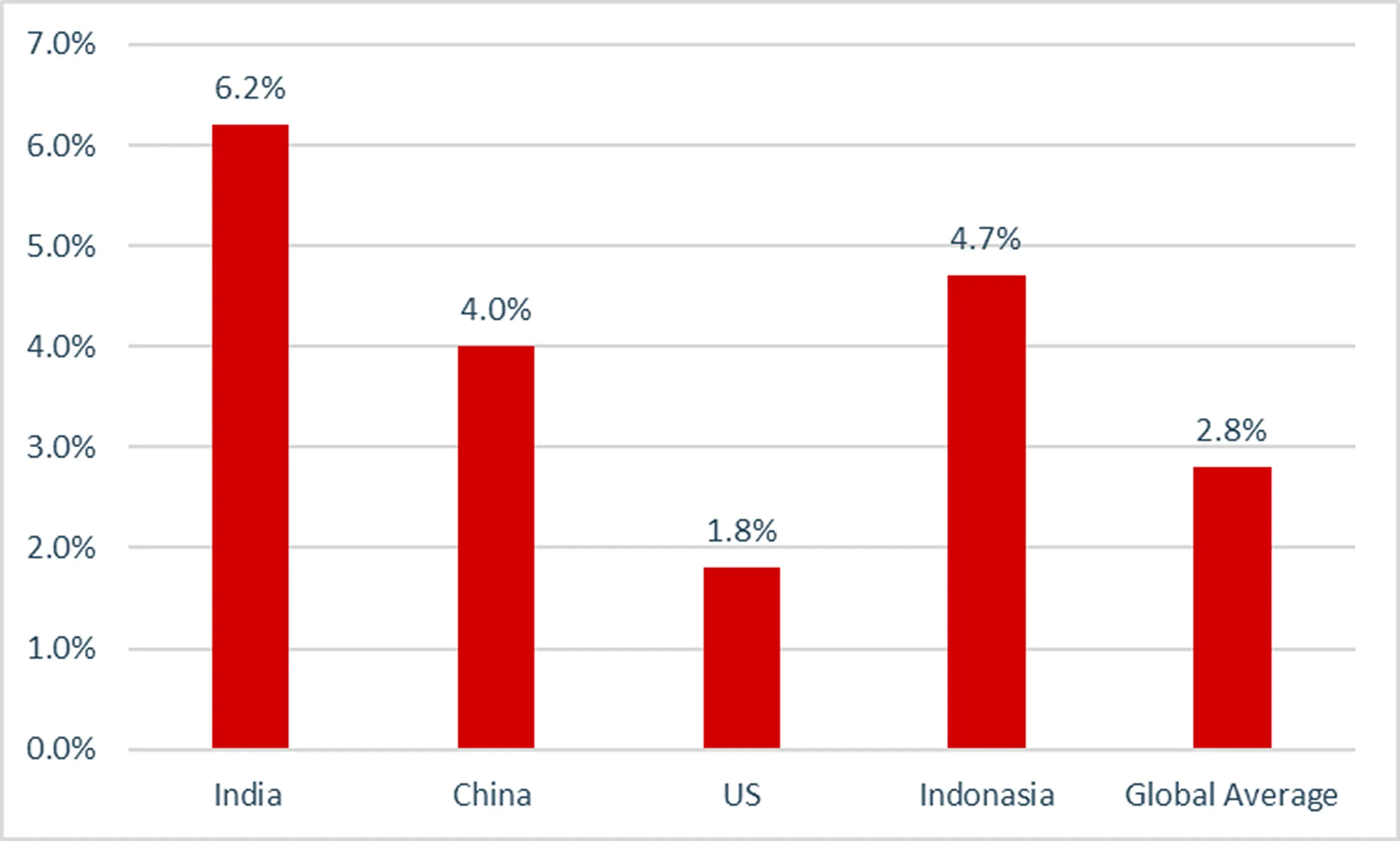
India recorded a robust real GDP growth of 6.2%, the highest among major global economies, underscoring its strong economic momentum. In comparison, China’s GDP grew by 4.0%. With a GDP of USD 4.19 trillion, the country is projected to sustain its growth trajectory, reaching an estimated USD 7.13 trillion by 2030.
Real gross domestic product (GDP) growth rate in 2025
India’s impressive economic growth is driven by several strategic advantages.
- Demographic: Its demographic dividend offers a young and dynamic workforce, with about 67% of the population in the working-age group, and the vast pool of skilled professionals fuels innovation and productivity. According to a UN report, India is projected to contribute around 22% of global workforce growth by 2030.
- Ease of Doing Business: India offers a highly conducive environment for business and investment, driven by a combination of economic resilience, policy reforms, and a large consumer base. Ranked 63rd in the World Bank’s Ease of Doing Business Index and 39th in the Global Innovation Index, India has demonstrated significant progress in simplifying regulatory frameworks and promoting innovation-led growth.
- Liberalised FDI: The country’s liberalised Foreign Direct Investment (FDI) policy allows up to 100% FDI in most sectors under the automatic route, reflecting its commitment to fostering an open and investor-friendly economy. This has been complemented by continuous government initiatives such as ‘Make in India’, ‘Digital India’, and ‘Startup India’, all aimed at enhancing industrial competitiveness, promoting entrepreneurship, and encouraging technology-driven solutions.
Rising Talent Availability
With over 65% of its population under 35 and a rapidly expanding working-age group projected to reach one billion by 2047, India offers a vast and dynamic pool of skilled, tech-savvy, and entrepreneurial talent ready to drive innovation and Global competitiveness.
Robust Supply Chain
India’s strong network of local raw material and component suppliers concentrated across major industrial hubs, enables companies to source domestically, cut logistics costs, shorten lead times, and reduce import dependence. This high availability supports agile and cost-efficient manufacturing.
Growing Demand
India’s vast and expanding consumer market, driven by rising incomes, a youthful workforce, and rapid urbanisation, is set to become one of the largest globally. With consumer spending projected to reach US$4.3 trillion by 2030.
GIFT City
Setting up a business in GIFT City is permissible for banks, insurance companies, capital markets, fund management, and fintech entities under a unified regulatory framework, offering attractive tax incentives and world-class infrastructure.
Government Support & Incentives
Progressive policies such as Special Economic Zones (SEZs), GIFT City (IFSC), and the Start-up India initiative, along with competitive corporate tax rates, are fostering a pro-business environment in India.
Rapid Digitalisation
With a telecom subscriber base of 1.2 billion and over 980 million internet users, rapid digitization is transforming industries and boosting efficiency. Moreover, as one of the world’s largest consumer markets, India presents immense domestic demand.
Ease of Doing Business in India
India has significantly transformed its business landscape by embracing digitalisation, simplifying regulations, and adopting investor-friendly policies. Today, company incorporation, tax registrations, and compliance filings can be completed online with real-time processing, reducing paperwork and government interaction. Single-window systems, integrated registrations, and streamlined approvals have made setup faster and more efficient for both domestic and foreign companies. At the same time, the government has strengthened transparency, reduced red tape, modernised infrastructure, and rationalised labour and tax laws to improve operational flexibility. Dispute resolution mechanisms have been improved to provide greater legal certainty. These combined reforms have boosted investor confidence and positioned India as a competitive global hub for manufacturing, services, and startups.
India’s Business Environment
Simplified Business Registration
During incorporation, a company can now obtain multiple essential registrations, such as GST, tax numbers, Employee Provident Fund, and employee insurance, through a single online process.
Digitisation of tax ID
Key tax identifiers like PAN (Permanent Account Number) and TAN (Tax Deduction and Collection Account Number) are fully digital, reducing processing time, and allowing companies to download certificates instantly.
Simplified Labour Regulations
Most labour-related registrations and filings, such as EPF, ESIC, and PF, are now available online. Companies can submit returns, update employee records, and maintain registers digitally, reducing paperwork.
Investor-focused reforms
The government has simplified foreign direct investment (FDI) rules, removed approvals in many sectors, and increased foreign ownership limits, while also promoting investment through SEZs, GIFT City, and GCC policies.
India’s Expanding Digital Economy
India has rapidly emerged as one of the world’s fastest-growing digital economies, driven by large-scale digital infrastructure, policy support, and mass technology adoption. With a telecom subscriber base of 1.2 billion and over 944 million internet users, and the world’s lowest data costs, India has built a strong foundation for its Digital Economy. Government platforms like UPI (Unified Payments Interface), and India Stack have transformed how individuals and businesses transact, access services, and verify information. India is also investing in emerging technologies such as AI, fintech, logistics tech, e-commerce, and digital health, supported by startup-friendly policies and global tech partnerships. Together, these initiatives position India not just as a user of technology but as a global leader shaping the future of the digital economy.
Why Global Brands Are Moving Manufacturing to India
India is rapidly emerging as the preferred global manufacturing base as rising labour and production costs in China push companies to seek more competitive options. By establishing operations in India, manufacturers gain access to one of the world’s largest and youngest workforces at significantly lower labour costs, along with abundant raw materials and a well-developed supplier ecosystem that reduces procurement and logistics expenses. The government actively incentivises companies to set up in India through Make in India, Production-Linked Incentive (PLI) schemes, tax benefits, duty exemptions, and simplified single-window approvals. Infrastructure is strengthening through industrial corridors, upgraded ports, highways, and dedicated freight networks, while fully digital customs, reduced documentation, and simplified clearances make exporting seamless. India’s strategic geographic location, positioned between Asia, the Middle East, Africa and with direct connectivity to Europe, makes it an ideal global supply chain and export hub, enabling efficient access to multiple high-growth markets. Additionally, India’s expanding network of Free Trade Agreements (FTAs) lowers tariff barriers, and Double Taxation Avoidance Agreements (DTAAs) ensure tax efficiency for cross-border operations. Combined with its massive domestic consumer market, India offers a cost-effective, incentive-driven, and future-ready environment for global manufacturers to establish and scale their operations.
India’s FTA and DTAA Network
India currently has 13 operational Free Trade Agreements (FTAs) and is engaged in negotiations for several more with key economies, including the European Union, US and Canada. These FTAs cover trade in goods, services, and investment cooperation, providing preferential access to Indian and partner-country markets through tariff reductions and simplified trade procedures.
In addition, India has signed Double Taxation Avoidance Agreements (DTAAs) with more than 95 countries, including major investment partners such as the US, UK, Singapore, Mauritius, Japan, and Germany. DTAAs prevent the same income from being taxed both in India and in the investor’s home country, ensuring fair tax treatment and enhancing capital repatriation ease.
These frameworks collectively make India a more attractive investment destination. FTAs lower trade barriers and expand export potential for companies operating in India, while DTAAs improve post-tax profitability and mitigate cross-border tax risks. Together, they foster regulatory predictability, reduce transaction costs, and enhance India’s competitiveness as a hub for manufacturing, R&D, and global services.
Why Set Up in India?
FTAs & DTAA
Simplified Compliance
Open FDI Policy
Single-Point Business Approval
India Promising Labour Force
India boasts one of the world’s largest and youngest working-age populations, providing a deep pool of skilled and semi-skilled labour at competitive costs. To fully harness this demographic advantage, the government launched the Skill India Mission in 2015, aiming to bridge the gap between industry demand and workforce skills. Under this initiative, millions of individuals receive vocational and technical training, apprenticeships, and industry-recognised certifications through programmes such as PMKVY, National Apprenticeship Promotion Scheme (NAPS), and Skill India Digital. The mission also integrates skill-based learning into schools, promotes international skill exchange, and leverages digital platforms for online training and job matching. These efforts, combined with rising workforce participation and ongoing investments in skill development, ensure a steady pipeline of industry-ready talent. This abundant, affordable, and increasingly skilled labour force positions India as an attractive destination for global manufacturing, services, and innovation-driven industries, supporting both domestic growth and international supply chain needs.
India’s Infrastructure
India has been investing heavily in modern infrastructure to support industrial growth, trade, and investment. Extensive development of highways, ports, rail networks, airports, and logistics hubs is improving connectivity within the country and with global markets. Special Economic Zones (SEZs), industrial corridors, and smart cities provide world-class facilities, streamlined approvals, and digital utilities for businesses. Upgraded power supply, water management, and digital infrastructure further enhance operational efficiency. These improvements reduce transportation costs, shorten lead times, and make it easier for companies to scale, export goods, and integrate into global supply chains, positioning India as a reliable and cost-effective hub for manufacturing and services.
Top Reasons to Invest in India
India stands today as one of the most promising global destinations for business expansion and investment. Backed by a strong growth trajectory, a young and skilled workforce, progressive policy reforms, and a rapidly expanding consumer market, the country offers a uniquely competitive ecosystem for global enterprises. Its liberal FDI framework, improving ease of doing business, and robust digital infrastructure further reinforce India’s position as a gateway to emerging opportunities across Asia and beyond. Looking ahead, sustained policy stability, continued infrastructure development, and the rise of new-age sectors such as fintech, renewable energy, and advanced manufacturing are set to propel India toward becoming a USD 7 trillion economy by 2030, solidifying its role as a leading hub for innovation, growth, and global enterprise.
Summary: Top 10 reasons to invest in India
| No. | Investor Benefit | Why India is Attractive |
|---|---|---|
| 1 | High ROI Potential | Fast-growing GDP, expanding sectors (manufacturing, digital, fintech, renewable energy). |
| 2 | Massive Consumer Demand | Large population, rising income levels, strong consumption-driven economy. |
| 3 | Cost Advantage | Lower labour, production, and operational costs compared to China and Western markets. |
| 4 | Government Incentives | PLI schemes, Make in India benefits, subsidies, tax holidays, duty exemptions. |
| 5 | 100% FDI Allowed in Most Sectors | Full ownership and control without a local partner requirement. |
| 6 | Ease of Doing Business Reforms | Single-window approvals, simplified regulations, digital compliance. |
| 7 | Strategic Location for Global Exports | Through India access to Asia, the Middle East, Africa, and Europe is ideal for supply chain hubs. |
| 8 | Export Benefits & FTAs | Lower tariffs, easier market entry through numerous Free Trade Agreements entered by India. |
| 9 | DTAA & Tax Efficiency | Large number of DTAA avoidance agreement signed by India enabling you to avoid double taxation on cross-border income. |
| 10 | Risk Diversification (“China + One”) | Reduces dependency on China, builds resilient supply chains. |