
India and New Zealand signed a Free Trade Agreement (FTA) on April 27, 2026, granting Indian exporters full market access to New Zealand. Earlier, in March 2025, the two countries had announced the launch of negotiations for the agreement, which were concluded by December 2025, making it one of India’s fastest-negotiated FTAs. The agreement reflects a shared commitment to strengthening economic ties and delivering commercially meaningful outcomes within a relatively short timeframe.
For foreign entities, the India–New Zealand FTA improves market access and tariff preferences, positioning New Zealand as a potential gateway to the wider Oceania and Pacific Island markets. Beyond trade in goods, the agreement also signals expanding opportunities in services and skilled mobility, further reinforcing India’s position as a reliable source of talent across priority sectors.
The agreement will enter into force once both countries complete their respective domestic ratification procedures. In New Zealand, the agreement will be reviewed by the Parliamentary Foreign Affairs, Defence and Trade Committee, which will undertake a national interest assessment and public consultation before submitting its report for parliamentary consideration. This process is expected to take several months before the agreement is formally implemented.
Tracing Growth in India-New Zealand Trade Relations
India and New Zealand have developed a steadily deepening trade relationship, positioning New Zealand as India’s second-largest trading partner in Oceania and 11th-largest two-way trading partner globally. While bilateral trade remains selective in scale, its strategic importance has grown alongside stronger commercial and demographic linkages between the two economies.
Recent trade trends highlight the growing commercial relationship between the two economies. Bilateral trade in goods and services reached approximately USD 2.4 billion in 2024. Merchandise trade alone recorded significant growth, reaching about USD 1.29 billion in FY 2024–25, reflecting strong year-on-year expansion in key export sectors. This growth is reinforced by New Zealand’s profile as a high-income, globally integrated economy, with a per capita income of USD 49,380 and total imports and exports of USD 47 billion and USD 42 billion, respectively, in 2024. For foreign enterprises, this underscores New Zealand’s role as a stable and sophisticated market within the Oceania region.
New Zealand’s strong outward investment orientation further strengthens the bilateral dynamic. With nearly 8 per cent of GDP invested overseas annually and total offshore investments valued at USD 422.6 billion as of March 2025, the country represents a meaningful source of global capital and long-term partnerships for emerging markets such as India.
Complementing trade and investment flows, a 300,000-strong Indian diaspora, accounting for nearly 5 per cent of New Zealand’s population, acts as a durable economic and cultural bridge. This community supports demand for Indian goods and services while facilitating business continuity, talent mobility, and cross-border collaboration, providing a robust foundation upon which the FTA builds.
Key Benefits of India-New Zealand FTA
The India–New Zealand Free Trade Agreement delivers a large set of advantages designed to deepen trade, facilitate services, and support cross-border investment. The elements of the FTA not only improve predictability but also improve access, long-term operating viability across both markets. The benefits outlined below frame the core outcomes of the FTA:
Tariff Liberalisation
The India–New Zealand FTA establishes a calibrated tariff framework that balances full export access with domestic safeguards. Upon implementation of the agreement, 100% of Indian exports will receive duty-free access to the New Zealand market, providing immediate certainty and improved competitiveness for Indian manufacturers and exporters. The agreement will come into effect after both countries complete their respective domestic ratification procedures.
India, in turn, has offered market access across 70.03% of its tariff lines, while retaining 29.97% under the exclusion list to safeguard sensitive sectors. The liberalised tariff lines are structured as follows:
30% of tariff lines:
Immediate elimination of customs duties, covering products such as wood, wool, sheep meat, and raw leather hides.
35.60% of tariff lines:
Gradual duty elimination over periods of 3, 5, 7, and 10 years. This category includes petroleum oils, malt extracts, vegetable oils, selected electrical and mechanical machinery, and peptones.
4.37% of tariff lines:
Tariff reductions (instead of full elimination), applicable to products such as wine, pharmaceutical products, polymers, aluminium, and articles of iron and steel.
0.06% of tariff lines:
Subject to tariff rate quotas (“TRQs”), including products such as honey, apples, kiwi fruit, and albumins, including milk albumin.
India has expressly excluded key sensitive products, including dairy and dairy derivatives, most animal products, select agricultural commodities, sugar, fats and oils, arms and ammunition, gems and jewellery, and certain copper and aluminium products. For foreign enterprises, this structure delivers clear timelines, predictable access, and a balanced liberalisation pathway aligned with long-term trade and sourcing strategies.
Mobility and Education
The FTA introduces a structured and predictable framework for talent mobility, with direct relevance for companies seeking access to skilled and globally mobile professionals. For the first time, New Zealand has signed an Annex on Student Mobility and Post-Study Work Visas, providing long-term policy certainty. Indian students are permitted to work up to 20 hours per week during studies, with assured post-study work options of up to three years for STEM bachelor’s and master’s graduates and up to four years for doctoral graduates, strengthening the future talent pipeline for employers.
In parallel, the agreement establishes dedicated professional pathways, including a quota of 5,000 visas for skilled Indian professionals for stays of up to three years across priority sectors such as IT, engineering, healthcare, education, and construction, alongside recognised Indian professions including AYUSH practitioners, yoga instructors, chefs, and music teachers. Additionally, a working Holiday Visa quota of 1,000 places annually enables short-term mobility and early-career exposure. Collectively, these provisions enhance workforce planning flexibility and support cross-border talent strategies for enterprises operating across India and New Zealand.
Services
The FTA delivers New Zealand’s most comprehensive services market access offer to date, reinforcing the agreement’s relevance for services-led enterprises. Commitments have been undertaken across 118 service sectors, providing enhanced certainty and non-discriminatory treatment for Indian service providers. In addition, the agreement extends Most-Favoured Nation (MFN) treatment across approximately 139 services sub-sectors, ensuring that any more favourable market access or liberalisation granted by either country to future FTA partners will automatically be extended to the other party. In practical terms, this provision provides long-term regulatory certainty for service providers and ensures that India benefits from any future improvements in services access offered by New Zealand to other trading partners.
In addition to market access commitments, the agreement also introduces frameworks to improve regulatory cooperation and reduce non-tariff barriers. Provisions covering sanitary and phytosanitary (SPS) measures, technical barriers to trade (TBT), and customs procedures aim to streamline trade processes and enhance regulatory transparency. These mechanisms are designed to facilitate smoother movement of goods while ensuring that quality and safety standards are maintained.
The agreement also creates opportunities for enhanced cooperation in the pharmaceutical and healthcare sectors. Measures aimed at strengthening regulatory cooperation may support faster market access for pharmaceutical products and medical technologies. Additionally, the recognition of traditional systems of medicine such as AYUSH further expands the scope for healthcare services, wellness products, and related professional exchanges between the two countries.
Investment and Market Access Gains
The FTA is anchored by a long-term investment commitment, with New Zealand set to invest USD 20 billion in India over a 15-year period, reinforcing confidence in India’s growth trajectory and operating environment. For foreign enterprises, this commitment signals deeper capital integration and expanded opportunities across manufacturing, infrastructure, and services-led sectors.
Beyond the investment commitment announced under the agreement, bilateral investment flows between the two countries have gradually expanded over time. New Zealand’s cumulative foreign direct investment (FDI) into India has reached approximately USD 75.11 million since 2000, with steady inflows recorded in recent years. Conversely, Indian companies have also increased their outward investments into New Zealand, with approaching USD 90 million across sectors such as IT services, hospitality, and manufacturing.
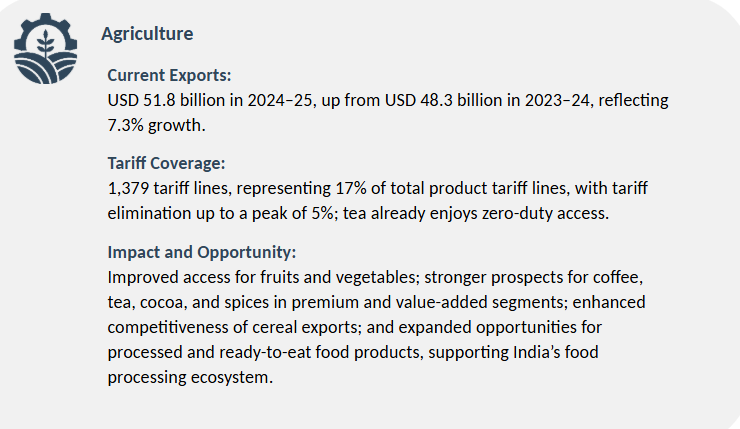
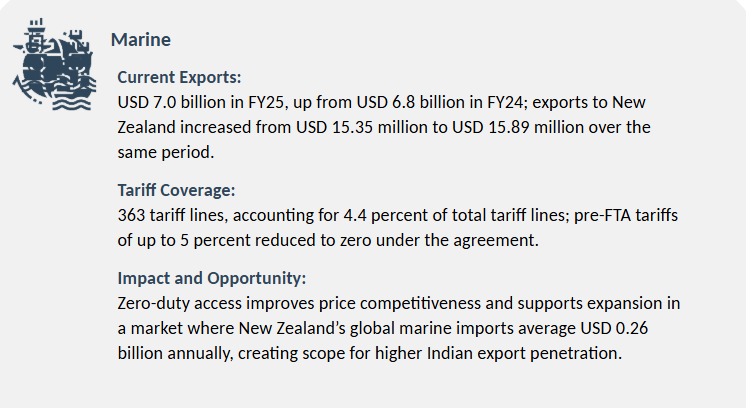
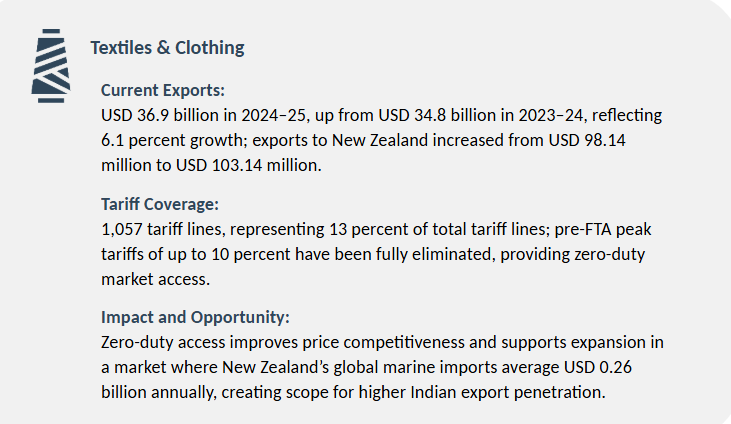
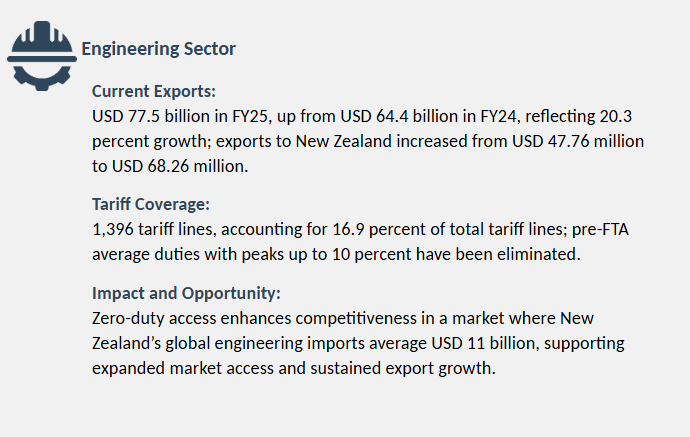
On market access, New Zealand has offered immediate zero-duty access on 100 per cent of its tariff lines (8,284 lines), materially improving competitiveness for Indian exporters. Tariffs of around 10 per cent previously applied on approximately 450 key export lines, including textiles and apparel, leather and headgear, ceramics, carpets, automobiles, and auto components, will be eliminated, with New Zealand’s average applied tariff of 2.2% reducing to zero. Collectively, these measures enhance trade efficiency, improve margins, and support scalable cross-border expansion for businesses operating between India and New Zealand.
Gains for Agro-Tech
The FTA introduces targeted agri-technology cooperation, with New Zealand agreeing to focused Action Plans for kiwifruit, apples, and honey aimed at improving productivity, quality, and grower capabilities in India. Cooperation includes Centres of Excellence, access to improved planting material, grower training, and technical support across orchard management, post-harvest practices, supply chains, and food safety.
These initiatives are aligned with controlled market access for select New Zealand agricultural products, including apples, kiwifruit, and Manuka honey, through a Tariff Rate Quota framework supported by minimum import prices and seasonal restrictions. Oversight by a Joint Agriculture Productivity Council ensures that technology transfer and market access progress in tandem, balancing consumer choice with protection of sensitive domestic agricultural sectors.
Conclusion
The India–New Zealand Free Trade Agreement marks a strategically significant step in India’s evolving trade architecture, delivering clear and commercially relevant outcomes across goods, services, investment, and mobility. For foreign business leaders, the agreement provides improved market access, reduced tariff barriers, and a predictable operating framework that supports long-term planning and cross-border expansion.
By combining full duty elimination on Indian exports with calibrated domestic protections and forward-looking cooperation in priority sectors, the FTA strengthens India’s position as a competitive manufacturing base, services hub, and talent partner. As implementation progresses, the agreement is poised to deepen bilateral integration, enhance supply chain linkages, and create sustained opportunities for enterprises engaging with both the Indian and New Zealand markets.
The agreement is also expected to benefit labour-intensive sectors and export-oriented MSMEs by improving price competitiveness in overseas markets. Reduced tariffs and improved market access for products such as textiles, leather goods, processed foods, and engineering products could support employment generation and strengthen India’s small and medium enterprise export ecosystem.