
In India, the existence of a corporate entity can be terminated either through formal winding up or by having its name struck off from the register maintained by the Registrar of Companies (ROC). The strike-off method is primarily utilised for closing inactive or non-operational entities. This procedure is regulated by the Companies Act, 2013, alongside the Companies (Removal of Names of Companies from the Register of Companies) Rules, 2016. While entity incorporation in India is relatively straightforward, the exit or closure process can occasionally be complex. Two distinct modes for name strike-off are prescribed by law:
Strike Off by the Registrar of Companies (ROC) – Initiated by the regulator for non-compliant or inactive companies.
Voluntary Strike Off by the Company – Initiated by the company itself, contingent upon fulfilling specific eligibility and compliance criteria.
Legal Framework for Strike-Off
Applicable Act: Sections 248 through 252 of the Companies Act, 2013 (‘the Act’).
Applicable Rules: Companies (Removal of Names of Companies from the Register of Companies) Rules, 2016.
Name removal may be executed by the Regulator or voluntarily by the Company.
ROC-Initiated Strike Off (Regulator-Driven Closure)
A notice for the strike-off of a company’s name shall be issued by the Registrar of Companies
(ROC) on the following grounds:
- If business has not been commenced within one year of incorporation; or
If business or operations have not been carried on for a period of two immediately preceding financial years without an application being made for dormant status under Section 455 of the Act.
Voluntary Strike Off by the Company (Company-Initiated Closure)
An application for striking off the name can be made by the Company if the following criteria
are fulfilled:
- The entity is not a listed company.
- It has not been delisted due to non-compliance with listing regulations.
- It is not classified as a vanishing company.
- It has not been subject to inspection or investigation.
- No prosecution is pending against the company, nor is any application for compounding
of offences pending. - No default has been made in the repayment of public deposits, etc.
- There are no charges pending satisfaction.
- It is not registered under Section 8 of the Companies Act, 2013, or Section 25 of the
Companies Act, 1956. - The Company has been inactive for at least 2 years.
- No bank account exists as of the date the application is filed with the ROC.
- Assets and liabilities are nil as of the application filing date.
- No dues are pending towards Income Tax, Banks, Financial Institutions, or other
Central/State Government/local authorities.
Annual Returns have been filed up to the date business was last carried out.
Restrictions on Voluntary Strike Off: When an Application Cannot Be Made
An application for name removal shall not be made if, at any time in the previous three months,
the company has:
- Changed its name or relocated its Registered Office from one state to another.
- Disposed of property or rights held by it for value.
- Engaged in any activity other than that which is necessary for making an application
under Section 248, statutory compliance, or concluding affairs. - Filed an application to the Tribunal for sanctioning a compromise or arrangement scheme
which is currently pending.
Been wound up under Chapter XX, whether voluntarily, by the Tribunal, or under the
IBC.
Process for Voluntary Strike Off: Step-by-Step Overview
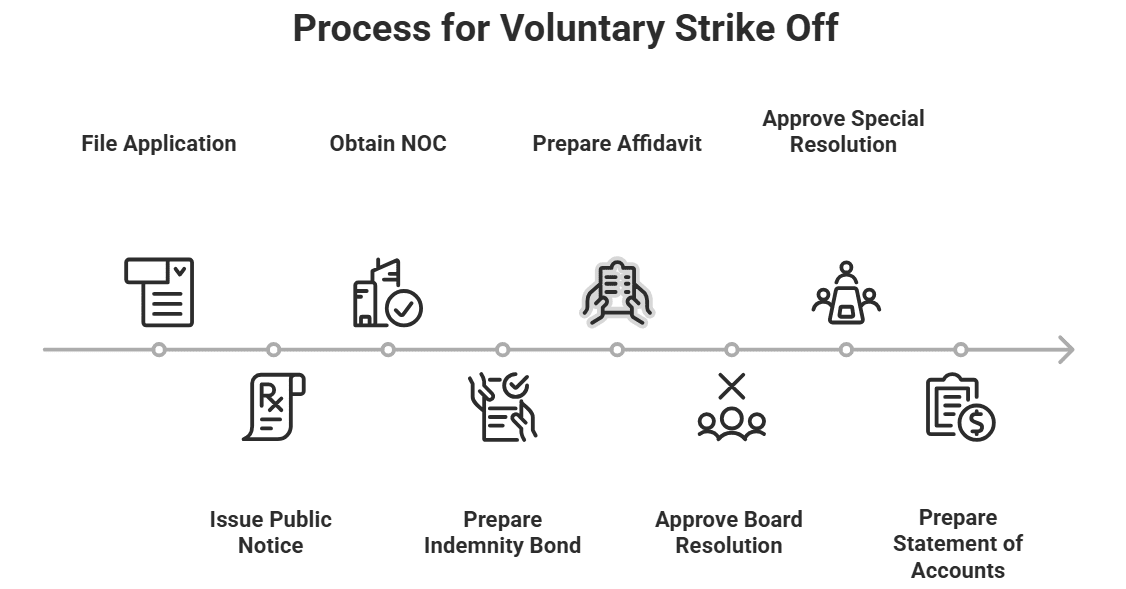
An application may be filed in E-Form STK-2 with a fee of Rs. 10,000 to the ROC for name
removal on grounds specified in Section 248(1). Upon receipt, a public notice shall be caused to
be issued by the Registrar.
The E-Form must be accompanied by a No Objection Certificate (NOC) from the sector-
specific regulator, if applicable, alongside the following documents:
- Indemnity bond duly notarized by every director in Form STK 3.
- An affidavit in Form STK 4 by every director.
- A copy of the board resolution approving the strike-off application.
- A copy of the special resolution certified by each director or consent of 75% of members
as of the application date.
A statement of accounts detailing assets and liabilities, made up to a day not more than
30 days prior to the application date, certified by a Chartered Accountant.
Tax Considerations
Capital Gains: Selling assets prior to strike-off could attract capital gains taxation.
Loss Set-off: Losses arising from the extinguishment of shares upon strike-off may be
available against other capital gains, subject to conditions.
Timeline for Strike-Off Process
The strike-off process generally requires approximately 6 months to complete. This method
offers a streamlined and legally recognized avenue for non-operational companies to exit the
corporate framework. By adhering to prescribed procedures under the Companies Act, 2013,
statutory obligations are met, liabilities settled, and records formally closed. Careful attention to
eligibility and tax considerations is essential to avoid complications.
Winding Up (Liquidation) of an Indian Company
Winding up is the formal process whereby a company permanently ceases operations, settles
outstanding debts, and distributes remaining assets to shareholders. Principally governed by the
Insolvency and Bankruptcy Code, 2016 (IBC), with limited “residual” matters under the
Companies Act, 2013, this ensures affairs are concluded in a compliant manner. A company may
opt for liquidation for reasons such as voluntary closure , financial difficulties , or lack of
business viability.
Depending on circumstances:
- Voluntary liquidation under Section 59 of the IBC can be initiated by a solvent
corporate person with no defaults. - Liquidation by NCLT order arises under Section 33 of the IBC (typically following a
failed CIRP).
“Winding-up” under the Companies Act, 2013 acts as a separate route petition able by
specific parties in limited scenarios.
Initiating the Liquidation Process
Under the IBC, the Corporate Insolvency Resolution Process (CIRP) not liquidation is filed for by creditors or the corporate applicant before the NCLT. Liquidation typically follows only upon an NCLT order under Section 33. Conversely, eligible parties may petition for winding-up before the NCLT under the separate route of the Companies Act, 2013.
Voluntary Liquidation in India (Solvent Company Closure)
Voluntary liquidation enables a solvent company to wind up operations in an orderly fashion. It
is applicable when the company wishes to close its affairs responsibly and has not defaulted on
any debt.
Eligibility – Who Can Opt for Voluntary Liquidation?
This procedure can be initiated by a corporate person in a no-default situation.
Key Preconditions – Board Resolution and Solvency Declaration
Management must adhere to requirements imposed under the Indian Companies Act and IBC
Voluntary Liquidation Regulations.
- Approval must be granted by the majority of directors via a signed board resolution.
A declaration verified by affidavit is required, stating that a full inquiry into company affairs has been made , the company is solvent , and the liquidation is not intended to defraud any person.
Supporting Documents Required
Audited financial statements and business records for the previous two years (or since incorporation).
A valuation report of the company’s assets, if applicable, prepared by a registered valuer.
When Do Companies Opt for Voluntary Liquidation?
- Although not entirely insolvent, a company might be on the brink of insolvency.
- To avoid a more chaotic compulsory liquidation process.
- When specific projects or limited objectives are accomplished.
- If a subsidiary no longer aligns with the parent company’s core strategy.
- When adverse market conditions affect future viability.
To amicably close the business due to irresolvable disputes among shareholders or
directors.
Why Opt for Voluntary Liquidation?
Control: Management retains control over strategic decisions regarding asset sales.
Risk Reduction: Proactive liquidation can reduce legal disputes and liabilities.
Relationships: Better relationships with creditors are maintained through timely settlements.
Clean Exit: Provides a legal dissolution and settlement of debts.
Cost: Often less expensive than court-ordered liquidation.
Procedure for Voluntary Liquidation: Step-by-Step
Engaging a reliable Company Registration consultant in India helps businesses stay compliant with evolving legal frameworks and procedural requirements. Their expertise ensures that every stage of the process is handled with accuracy, reducing the risk of delays or penalties. This guidance becomes especially important when dealing with regulatory obligations and formal closures.
Management is required to follow the Indian Companies Act and IBC Voluntary Liquidation
Regulations.
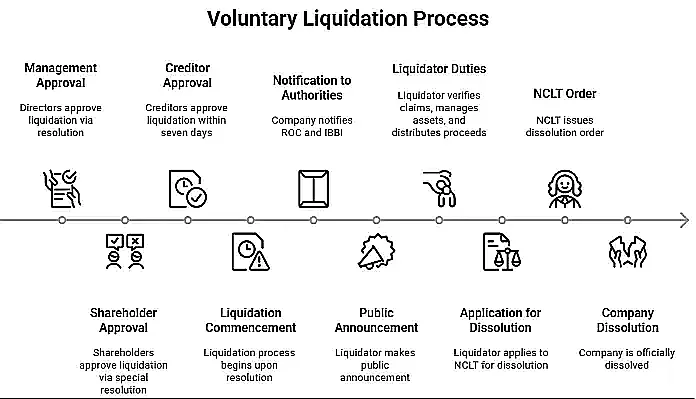
Director Approval: Majority of directors sign a board resolution and make the solvency
declaration.
Shareholder Approval: Majority of shareholders must approve via special resolution
(75% consent).
Creditor Approval: Creditors representing two-thirds in value must approve within
seven days.
Commencement: The process begins on the resolution date.
Notification: The ROC and IBBI must be notified within seven days.
Public Announcement: The liquidator must make a public announcement within five
days of appointment.
Liquidator Actions: Once appointed, the liquidator verifies claims , takes custody of
assets , realizes the estate , and distributes proceeds.
Dissolution: The liquidator applies to the NCLT for dissolution; the company is officially
dissolved once the order is passed.
Timeline and Compliance Highlights for Voluntary Liquidation
Stakeholder List: Prepared within 45 days from the last date for receipt of claims.
Completion: Liquidation should ordinarily be completed within 270 days.
Early Completion: If no claims are received, the final report may be submitted within
90 days.
Final Report: Submitted by the liquidator along with a compliance certificate.
Compulsory Liquidation: Court-Mandated Winding Up
Compulsory liquidation is a legal process wherein operations are forced to wind up under NCLT
supervision. Unlike voluntary liquidation, this is initiated by an NCLT order under Section 33 of
the IBC. It ensures creditor claims are addressed systematically.
Legal Framework
Prescribed under the Insolvency and Bankruptcy Code, 2016, with the NCLT serving as the
Adjudicating Authority.
Initiation – How Compulsory Liquidation Begins
Creditors may initiate CIRP before the NCLT if a default of at least ₹1 crore exists. Liquidation
may subsequently be ordered if CIRP fails or the Committee of Creditors opts for it.
Timeline and Regulatory Constraints
CIRP: 180 days plus up to 90 days moratorium.
Liquidation Target: 1 year (with limited extensions for going-concern sales).
Closing a Dormant Company: Simplified Strike-Off Process
A shelf or dormant company can be closed via a streamlined strike-off process under Section 248
using Form STK-2. The form is filed with the ROC, signed by a duly authorised director.
Eligibility Criteria for Dormant Company Strike-Off
The company must have no liabilities and either:
- Failed to commence business within one year of incorporation; or
Not carried on business for the two immediately preceding financial years without
applying for “dormant company” status.
Overall, winding up or liquidation in India is a structured process designed to ensure orderly, transparent, and compliant closure. Voluntary liquidation allows solvent companies to control the process, maintain good relationships with creditors, and exit efficiently, while compulsory liquidation safeguards creditor interests in cases of insolvency. Additionally, streamlined procedures exist for dormant or shelf companies through strike-off under the Companies Act,
2013. Whether voluntary or compulsory, these mechanisms provide legal certainty and protection for all stakeholders.