
Types Of Business Structures in India: LO/BO/PO
India offers a diverse and well-regulated environment for global businesses looking to establish a presence without incorporating a full-fledged company. Among the most preferred entry options are Liaison Office (LO), Branch Office (BO), and Project Office (PO), each designed to serve specific business objectives and operational needs. Understanding these structures is essential for foreign entities aiming to operate efficiently while remaining compliant with Indian regulations. Many businesses also explore company registration services in India to evaluate the most suitable entry route and ensure a smooth setup process from the outset.
Types of Business Structures in India
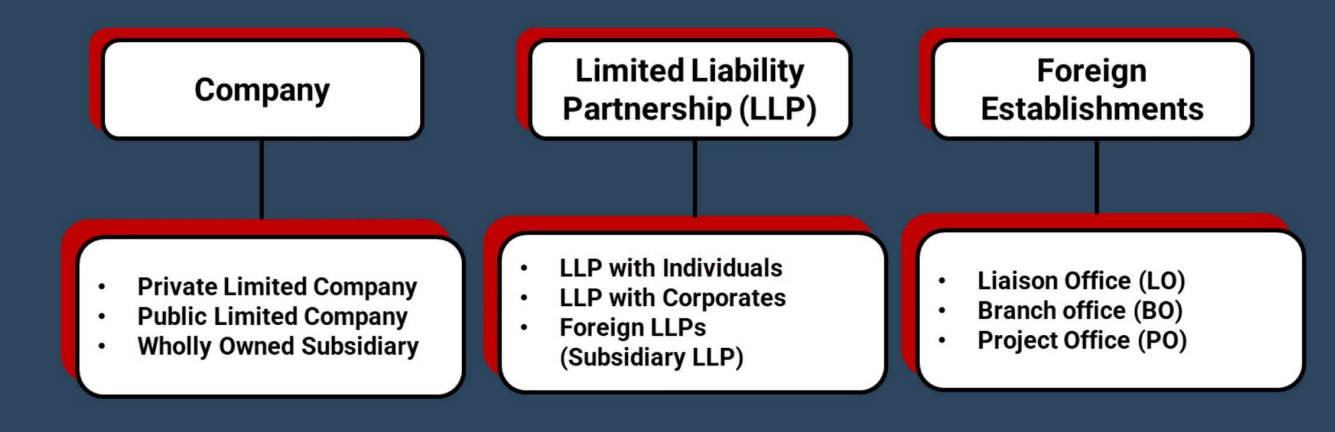
Liaison Office (LO)
1. What is a Liaison Office (LO)?
A Liaison Office (LO) serves as a communication channel between the Head Office (HO) and entities in India but cannot engage in commercial, trading, or industrial activities or generate income in India.The validity period of an LO is generally 3 years.
2. What are the eligibility requirements for establishing LO in India?
A foreign entity applying for a Liaison Office (LO) in India must meet the following financial criteria:
- Profit-making track record in the home country for the last 3 financial years
- Net worth of at least USD 0.05 million (or its equivalent)
Branch Office (BO)
3. What is a Branch Office (BO)?
Branch Office (BO) in relation to a company, means any establishment described as such by the
company. Generally, a BO is an extension of a company incorporated outside India. It is engaged in
the activity in which the parent company is engaged.
4. What are the eligibility requirements for establishing BO in India?
A foreign entity applying for a Branch Office (BO) in India must meet the following financial criteria:
- Profit-making track record in the home country for the last 5 financial years
- Net worth of at least USD 0.1 million (or its equivalent)
5. Which activities can be undertaken by a Branch Office (ВО) in India?
A BO is allowed to undertake only RBI-permitted activities, and they are as follows:
- Export/Import of goods.
- Rendering professional/consultancy (other than legal services), Information Technology (IT), andsoftware development services in India.
- Rendering technical support to the products supplied by parent/group company.
- Carrying out research work in which the parent company is engaged.
- Promoting technical/financial collaborations between the Indian and overseas group companies.
- Representing the parent company in India and acting as a buying/selling agent for the parent
company in India. - Foreign airline/shipping company.
Project Office (PO)
6. What is a Project Office (PO)?
A Project Office (PO) is a place of business in India that can be established by a company
incorporated outside India to undertake and execute a project in India from an Indian company. The validity period of a PO is limited to the tenure of the project.
7. What is the process for applying for a PO in India?
The application to establish a Project Office (PO) in India must be submitted to a designated AD Bank using Form FNC, along with the necessary annexures.
Conclusion
Liaison Offices (LO), Branch Offices (BO), and Project Offices (PO) offer distinct entry routes for foreign companies planning to establish a presence in India. Each structure serves a specific purpose, with LOs focusing on representation, BOs enabling operational activities within permitted limits, and POs dedicated to project-based execution. The choice of structure depends on the business objectives, scale of operations, and regulatory considerations. Understanding the eligibility criteria, permitted activities, and compliance requirements is essential to ensure a smooth setup and ongoing operations. Regulatory approvals, especially from the Reserve Bank of India, play a crucial role in the establishment process. Businesses must also align their strategies with India’s foreign exchange and corporate laws. Engaging a professional company registration consultant in India can help simplify the process, ensure compliance, and support efficient market entry.