
Types of Business Structures in India
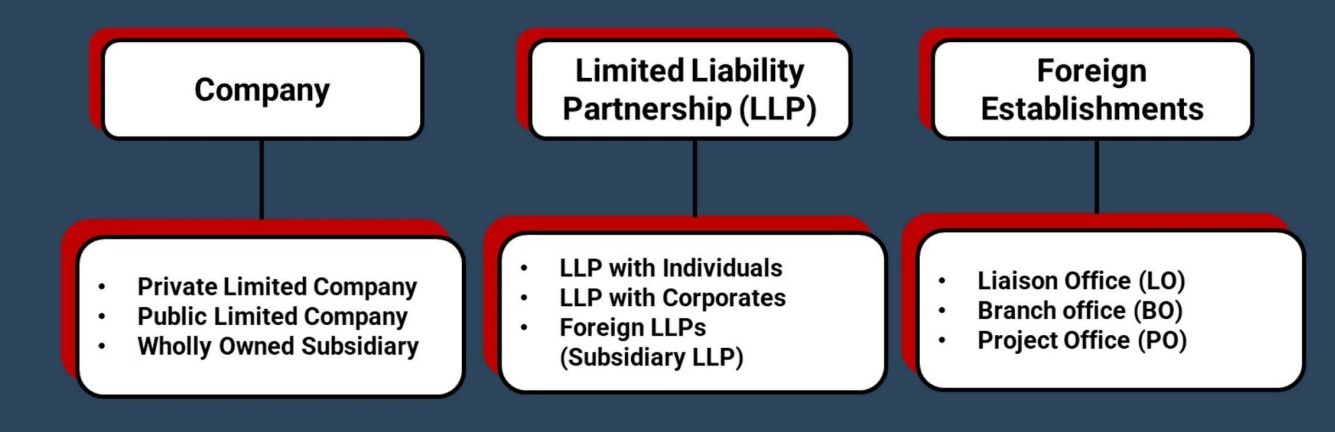
Limited Liability Partnership (LLP)
1. What is a Limited Liability Partnership (LLP)?
A Limited Liability Partnership (LLP) in India, governed by the LLP Act, 2008, combines the benefits
of a partnership and a company. It is suitable for small-scale businesses, particularly those in the
service sector. Additionally, foreign ownership is permitted in an LLP.
2. What are the advantages of establishing a Limited Liability Partnership in India?
A Limited Liability Partnership (LLP) provides key advantages such as limited liability protection for
partners, flexibility in management and ownership, and fewer regulatory requirements compared to a company.
Wholly owned Subsidiary (WOS)
3. What is a Wholly owned subsidiary?
A Wholly Owned Subsidiary is a company in which 100% of the shares are owned by another
company, known as the parent company or holding company. Since the parent company holds full
ownership, it has complete control over the subsidiary’s management, operations, and decision making.
4. What are the advantages of establishing a wholly owned subsidiary?
A wholly owned subsidiary offers a wide range of benefits such as full control over operations in
India, ease of management, tax benefits, and compliance with local laws and regulations.
Common FAQs
5. Is a Limited Liability Partnership or a wholly owned subsidiary considered a separate legal entity?
Yes, both an LLP (Limited Liability Partnership) and a wholly owned subsidiary are separate legal
entities. An LLP is distinct from its partners, with contracts signed in its name, which helps to build
trust with stakeholders, customers, and suppliers.
6. What is the time frame for establishing a Limited Liability Partnership and a wholly owned subsidiary with a foreign holding in India?
The time frame for incorporating an LLP typically takes around 1 month whereas for WOS it typically takes around 1.5 months in India.
Common FAQs
7. What is the flexibility of a Limited Liability Partnership and a wholly owned subsidiary to raise capital/funds?
Both a Limited Liability Partnership (LLP) and a Wholly Owned Subsidiary (WOS) have the flexibility
to raise capital. A company can raise funds by issuing shares whereas an LLP cannot issue shares to
raise funds, instead, new partners can be added through a partnership agreement, with funding
structured as capital contributions or loans from external investors.
Conclusion:
Choosing the right business structure in India is critical for operational efficiency, regulatory compliance, and long-term growth. Whether you opt for a Limited Liability Partnership (LLP) or a Wholly Owned Subsidiary (WOS), understanding the advantages, legal requirements, and capital-raising flexibility of each option ensures informed decision-making. Engaging expert guidance can simplify the incorporation process, minimize compliance challenges, and help businesses capitalize on opportunities in the Indian market.
For seamless setup and professional assistance, partnering with a Company registration consultant in India can provide the expertise and support needed to establish your business successfully.