
Introduction
GST registration is the process of enrolling a business under India’s GST system, enabling it to legally collect GST and claim input tax credit. It is mandatory for businesses crossing the prescribed turnover threshold to ensure compliance and smooth operations.
GST registration is the process of enrolling a business under India’s GST system, allowing it to legally collect tax and claim input tax credit. It becomes mandatory once the prescribed turnover limit is crossed. Understanding the GST registration procedure helps businesses ensure compliance, maintain proper invoicing, avoid penalties, and operate smoothly while building credibility with customers, suppliers, and government authorities across India.
Who Must Register Under GST (Eligibility)
GST registration is mandatory for certain categories of businesses and individuals, depending on their turnover, nature of supply, and mode of operation. It also applies to entities involved in interstate supply of goods or services, even if their turnover is below the threshold limit.
Threshold Turnover Limits
| Particulars | Special Category States (Category I) | Special Category States (Category II) | Rest other States |
| Supply of only Services/ Goods or Services | Rs. 10 Lakhs | Rs. 20 Lakhs | |
| Supply of only Goods | Rs. 10 Lakhs | Rs. 20 Lakhs | Rs. 40 Lakhs |
GST registration is mandatory when a business’s annual aggregate turnover exceeds the prescribed threshold limits as tabulated under:
- Particulars
- Special Category States (Category I)
- Special Category States (Category II)
- Rest other States
- Supply of only Services/ Goods or Services: Rs. 10 Lakhs (Category I), Rs. 20 Lakhs (Category II)
- Supply of only Goods: Rs. 10 Lakhs (Category I), Rs. 20 Lakhs (Category II), Rs. 40 Lakhs (Rest other States)
Special Category States (Category I) include Manipur, Tripura, Nagaland, and Mizoram. Special Category States (Category II) include Meghalaya, Arunachal Pradesh, Sikkim, Telangana, Uttarakhand, and Puducherry.
Interstate Suppliers
Any person engaged in the inter-state supply of goods is mandatorily required to obtain GST registration, irrespective of turnover limits. This provision applies even to small businesses, as supplying goods outside the home state triggers compulsory registration under GST law, ensuring proper tax compliance and reporting.
Mandatory Registration for Special Categories
The following persons must register under GST irrespective of turnover:
- E-commerce sellers supplying through online platforms
- Casual taxable persons making temporary taxable supplies in another state
- Non-resident taxable persons supplying goods or services in India
- Person liable to pay tax under reverse charge mechanism u/s 9(3) of CGST Act 2017
- Agent supplying on behalf of principal.
- Persons who are required to deduct tax u/s 51 or collect tax u/s 52 of CGST Act 2017.
- Person supplying OIDAR services to a person in India, excluding registered persons.
- Input Service Distributer (ISD)
- Person supplying online money gaming from a place outside India to a person in India
Voluntary Registration
Businesses that are not required to register can still opt for voluntary GST registration. Once registered voluntarily, all GST provisions become applicable to the taxpayer.
Overview of GST Registration Procedure
GST registration in India is a free and fully online process carried out through the official government portal, allowing businesses to apply from anywhere without visiting tax offices.
The procedure of registration under GST is completed by filing Form GST REG-01, which is divided into two parts Part A containing basic details of applicant and Part B for detailed business information and document submission.
Understanding the procedure for registration under GST helps applicants avoid common mistakes that may lead to delays or rejection of the application. Once the form is submitted successfully, a Temporary Reference Number (TRN) is generated to continue and track the process.
The registration process under GST includes verification by the tax officer, who may request clarification or additional documents if required. Upon approval, the applicant receives the GSTIN and the certificate of registration electronically, enabling the business to start issuing GST-compliant invoices and operate legally.

Step-by-Step GST Registration Process (Online)
GST registration in India is an online process that is completed through the official GST portal Applicants must create a user account, validate their PAN, and verify their mobile number and email address through OTP authentication before proceeding with the form. The portal guides users step by step to enter business details, upload supporting documents, and submit the application digitally without any physical paperwork. This streamlined system aligns with broader digital compliance initiatives such as Company Registration consultant in india, making statutory registrations more efficient and accessible. Below is the detailed online GST registration process for GST:
Key GST Registration Steps (h4)
- Submission of Form GST REG-01 with accurate business and personal details
- Generation of ARN for application tracking
- Verification of documents by the GST officer
- Response to queries, if raised by the department
- Issue of GSTIN and Registration Certificate upon approval
GST Registration Process Step by Step (h3)
The GST registration process step by step ensures that applicants follow a structured path from form submission to approval without confusion. Understanding these stages reduces errors, prevents rejection, and speeds up approval timelines for new businesses and existing entities.
For businesses undergoing Pvt Ltd company registration in India, applying for GST soon after incorporation ensures timely tax compliance and uninterrupted business operations from the very beginning.
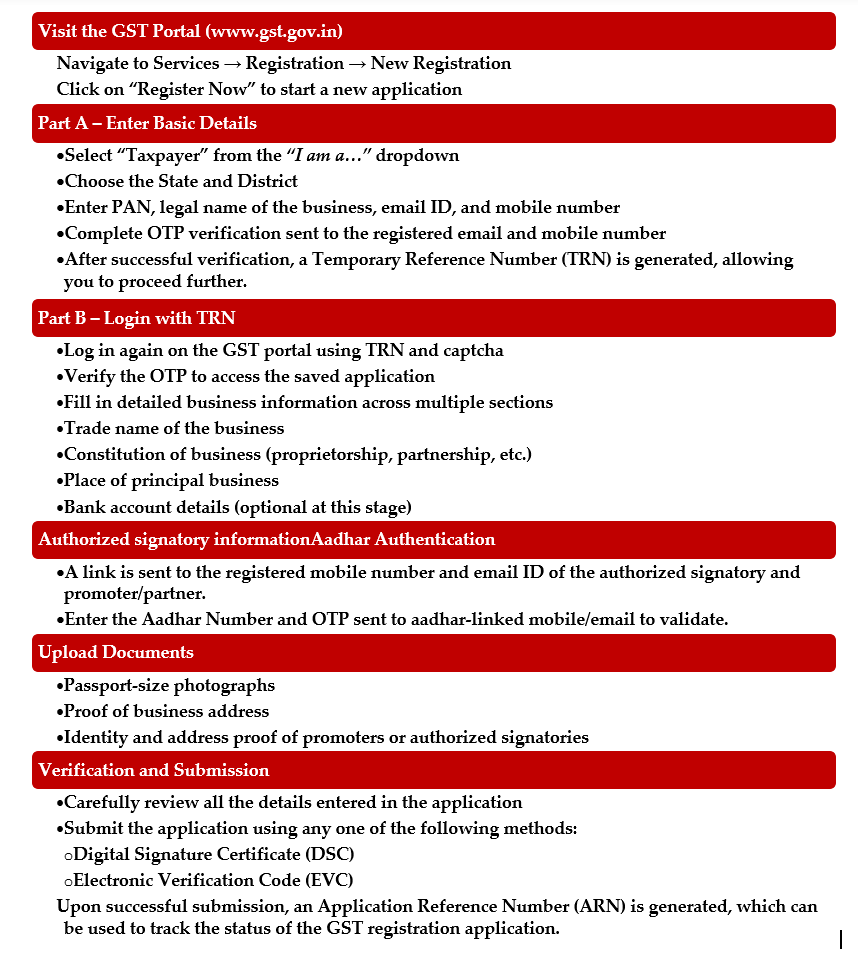
What Happens after Submission?
Once the GST registration application is successfully submitted, Application Reference Number (ARN) is generated through which the applicant can track its progress and wait for verification by the tax authorities.
The application is then processed by GST tax officers, who verify the details and documents submitted. If all information is found to be correct and complete, the application is approved without any further clarification.
On approval, the GST Registration Certificate (Form GST REG-06) is issued electronically on the GST portal. This certificate contains the GST Identification Number (GSTIN) and serves as official proof of GST registration. In most cases, the GST registration process is completed within 7-10 working days, provided all documents and details are accurate.
Documents Required for GST Registration
To complete GST registration smoothly, applicants must keep certain basic documents ready before starting the online application. Providing correct and clear documents helps avoid delays in approval.
|
Document |
Purpose |
| PAN of the Business | Mandatory for GST registration and tax identification |
| Aadhaar / ID Proof of Authorized Signatory | Identity verification of the person filing the application |
| Proof of Business Address | To verify the place of business (electricity bill, rent agreement, etc.) |
| Bank Account Proof (Optional at time of registration) | For linking business bank details with GST |
| Proof of Constitution of Business | Confirms business structure (partnership deed, incorporation certificate, etc.) |
| Photographs of Promoters / Authorized Signatories | Required for identification |
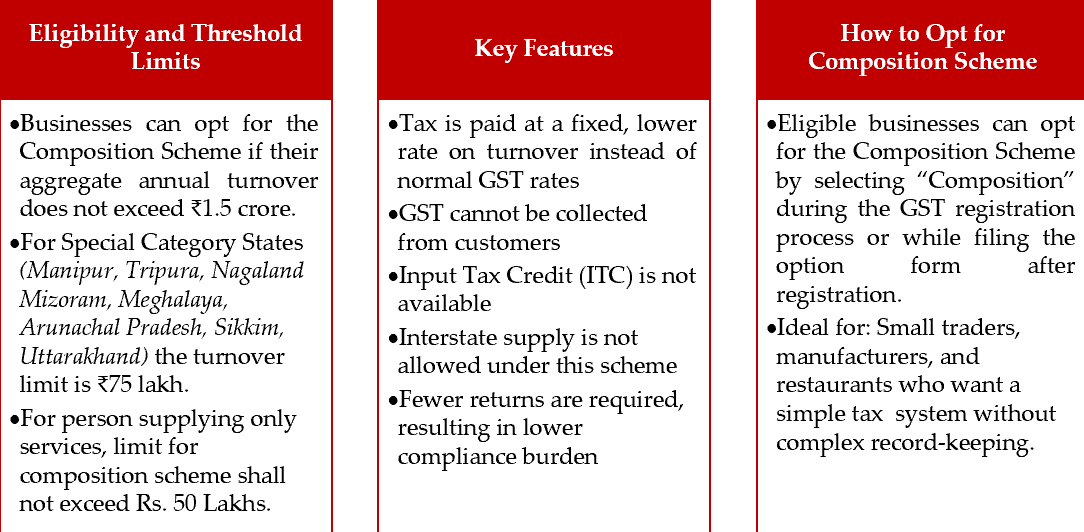
Composition Scheme Registration (Optional)
The GST Composition Scheme is a simplified taxation option for small businesses that want lower tax liability and reduced compliance requirements. It is suitable for taxpayers who primarily deal in intra-state supplies and do not want to manage complex GST filings.
Penalty for Non-Registration under GST
Failure to register for GST when legally required attracts a penalty of ₹10,000 or 10% of the tax due, whichever is higher, as per Section 122 of the CGST Act, 2017. If intentional tax evasion is proven, the penalty can reach 100% of the tax evaded, with potential prosecution and imprisonment in extreme cases
Additional Financial and Legal Consequences
Non-registration can also lead to denial of input tax credit, which increases the overall tax burden on the business. Authorities may demand backdated tax payments along with interest for the period of non-compliance. This can significantly affect cash flow and profitability, especially for small and growing enterprises.
Business Impact and Compliance Risk
Operating without GST registration affects business credibility and restricts the ability to deal with registered vendors and corporate clients. Many organisations avoid working with unregistered entities due to compliance risks, which may result in loss of contracts and business opportunities. Seeking professional indirect tax advisory services can help businesses understand their registration liability and avoid such penalties.
Importance of Timely Registration
Timely GST registration ensures smooth business operations, uninterrupted invoicing, and lawful tax collection. It protects the business from legal notices, departmental scrutiny, and financial penalties arising from delayed compliance.
Conclusion
GST registration is a crucial step for businesses operating in India, as it ensures legal compliance and enables smooth participation in the formal tax system. From understanding eligibility and required documents to completing the online registration process and post-submission formalities, the GST registration procedure is straightforward when followed step by step.
Businesses should ensure timely GST registration to avoid penalties and operational hurdles. Proper registration not only helps in complying with tax laws but also builds credibility and facilitates seamless business growth.
As GST compliance forms an integral part of starting and running a lawful enterprise, many businesses seek professional assistance to manage registrations and related formalities efficiently. We also assist entrepreneurs and companies with:
Frequently Asked Questions (FAQs)
1. How long does GST registration take?
GST registration is usually completed within 7–10 working days, provided all details and documents submitted are accurate and complete. Delays may occur if the tax officer raises a query or requests additional clarification during the GST registration procedure. Timely response to such queries helps speed up the approval process.
2. Is online GST registration free?
Yes. GST registration is completely free on the official GST portal. The government does not charge any fee for GST registration. However, businesses may choose professional support to better understand the procedure for registration under GST and avoid filing errors.
3. Can you register without Aadhaar authentication?
Yes. GST registration can be completed without Aadhaar authentication. In such cases, the application may be subject to physical verification or additional checks by the GST department. This may slightly increase the processing time in the registration process under GST.
4. Do you need to register separately for each state?
Yes. GST registration is state-specific. If a business operates in multiple states, it must obtain separate GST registration for each state. Each registration follows the same procedure of registration under GST and results in a unique GSTIN for that state.