
Entering the Indian market offers significant rewards, yet it is accompanied by considerable complexities. The true challenge lies not in recognising the country’s potential, but in adeptly navigating its dynamic regulatory and legal landscape. With a myriad of laws governing entities across diverse sectors, the process of incorporation and compliance can appear intricate, particularly during the initial planning phase.
Consequently, gaining a thorough understanding of the legal and compliance framework from the outset is crucial. This knowledge empowers businesses to select the appropriate ownership structure and design a scalable operating model, thereby establishing a solid foundation for a seamless and compliant entry into one of the world’s most promising markets.
This guide seeks to demystify the entire process of establishing a manufacturing company in India, providing step-by-step insights to enable investors to navigate the regulatory landscape effectively and harness the vast potential of the Indian economy.
Key Benefits of Setting Up a Manufacturing Company in India
India has emerged as the fastest-growing major economy in the world, with an annual growth rate of about 6.5% which is expected to continue for the next financial year as well. By the end of this decade, India is set to become the third-largest economy with a projected GDP of $7 trillion.
This momentum is powered by the following:
- A highly skilled workforce, with over 22.7 million candidates, skilled under the Skill India Programme as per IBEF reports.
- A large and growing consumer base. As per the latest statistics, consumer spending is projected to reach $4.3 trillion by 2030.
- Government initiatives such as the Information Technology Act, the National Digital Health Mission, and enhanced cybersecurity measures have strengthened India’s technology ecosystem.
- GIFT City – Positioning India as a Global Tech Hub
The International Financial Services Centre (IFSC) at GIFT City offers a world-class business environment with regulatory flexibility, tax incentives, and access to global capital. With a strong focus on technology-driven services, GIFT City positions India as a leading hub for fintech, IT, and digital services, reinforcing its role in the global technology landscape. Companies setting up in GIFT IFSC enjoy significant advantages, including zero corporate tax, exemption from indirect taxes and customs duties, no securities or commodities transaction tax, and fast-track approvals, making it a highly business-friendly destination.
Types of business entity & structures in India For Manufacturing Company
Choosing a business structure is a strategic decision depending on the nature of your business activity, it’s important to evaluate the available entity structures and choose the one that best supports your long-term growth and operational goals in India.
Broadly, there are four main types of business structure you can consider:
- Companies: Whether privately or publicly owned, it gives full operational control and are well-suited for businesses that want a strong and scalable presence in India.
- Limited Liability Partnerships (LLPs): It combines the benefits of a traditional partnership with limited liability protection and offer more flexibility in management and lesser compliance.
- Foreign Establishments: Foreign Establishments include three forms:
- A Liaison Office, which acts as a communication channel between the parent company and Indian stakeholders. It cannot engage in any commercial or revenue-generating activity.
- A Branch Office, which can carry out business activities in India similar to its parent company, but within a defined scope.
- A Project Office (PO), which is set up for executing a specific project in India and exists only for the duration of that project.
4. Joint Ventures: It is a great option for foreign companies looking to partner with Indian businesses, bringing together shared expertise, local market knowledge, and resources.
Among these options, we believe that the Private Limited Company structure stands out as the most preferred for foreign investors. It offers:
- ease of capital infusion,
- flexibility in fundraising, and
- a relatively efficient tax structure.
Each business structure carries distinct tax implications, making it essential to evaluate the model from both a regulatory and fiscal perspective. The following section outlines the applicable tax profiles for different business structures in India.
- Resident Entities – It includes Companies and LLPs. The tax profile of these business models is summarised below:
- The entire global income is taxable in India
- Corporate tax is lower compared to foreign establishments. The Corporate tax for a company is lower compared to other entity types
- There is no risk of Permanent Establishment (PE) provided the transactions between related parties are undertaken at arm’s length pricing in compliance with Transfer pricing regulations.
- Foreign establishments – It includes Branch, Liaison, or Project Offices. The tax profile of these business models is summarised below:
- Income received and generated from India is taxable, but at higher corporate tax rates
- There is a higher risk of Permanent Establishment (PE) in the case of Branch & PO
- There are certain restrictions on the permissible activities to be undertaken by these establishments.
A Step-by-Step Guide to Manufacturing Company Registration in India
Forming a company in India entails several crucial steps, beginning with the selection of a business entity that best aligns with your strategic objectives. The following outlines the step-by-step procedures for establishing a business with Company Registration consultant in india.
Step 1: Choose the Right Business Entity in India
Selecting an appropriate business entity is the foundational step when registering a company in India. It determines your legal status, compliance obligations, investment options, and liability. India offers several top business entities, each with its own features and suitability for different situations.
After choosing the business entity, the below are the steps to be followed:
| Sr No | Process | Estimated No of Days required |
| 1 | Data Gathering as per the checklist to be provided/provided by ICI | – |
| 2 | Preparation of Board Resolution for Name approval (applicable in case the majority shareholder is a body corporate) | 1-2 working days |
| 3 | Approval of the board resolution by the shareholding entity
(applicable in case the majority shareholder is a body corporate) |
– |
| 4 | Name application with Registrar of Companies (ROC) on receipt of a copy of the approved Board Resolution | 4-5 working days |
| 5 | On receipt of approval on the proposed name, preparation of ROC documentation having the approved name by ICI for proposed shareholders, directors, authorized signatories, etc. | 7-8 working days |
| 6 | Self-attestation, Notary & apostilling of the documentation prepared by ICI, along with KYC documents in the country of residence of foreign parties. Only self-attestation in case of Indian residents | – |
| 7 | Submission to Registrar of Companies of the Incorporation form | 5-7 working days |
| 8 | Direct Approval or Additional requirement from Registrar of Companies (ROC) (depends from case to case) | 3-4 working days to receive communication from ROC |
| 9 | Issue of Certificate of Incorporation (COI) by Registrar of Companies (ROC) on satisfaction of all its requirements, along with the Company PAN Number & TAN number from the Income Tax Department | – |
| 10 | First Board meeting (BM) of the company to be held within the prescribed time from the date of incorporation under the Companies Act | 5-7 working days from the date of receipt of complete information required for the BM |
| 11 | Opening of the bank account. In case of having signatories based out of India, every banker has their own KYC norms to be followed. | Depends on the bank chosen |
| 12 | Capital infusion by shareholders into the bank account of the proposed Indian entity | – |
| 13 | Certificate of Commencement (COC) of Business from ROC on receipt of bank statement reflecting the capital credit (Post receipt of COC from ROC, the company can commence its business operations in India) | 1-2 working days |
| 14 | Obtaining mandatory licenses as required under GST, IEC, FCGPR process with RBI for share capital infusion, etc. | To be provided for registrations applicable separately |
Note: The time taken for completion of the entire foreign incorporation is totally dependent on the time required for apostilling and notary in the country of residence of the foreign party by the requisite authorities. Generally, completion of the process (up to Step 9) takes a bare minimum of a month and a half.
Step 2: Understanding if the proposed business activity falls under the Automatic or Government approval route.
To ensure a smooth registration process of an Indian Entity, it is important to understand applicable FEMA & FDI Regulations on the proposed business activity.
A key consideration under FEMA is identifying the correct route for the foreign direct investment.
The first step in this process is to determine the sector classification of the proposed business activity. Based on this, the investment will either fall under the Automatic Route or the Government Route.
Based on the detailed proposed activities in the manufacturing sector, India Company Incorporation can advise on additional FDI-specific requirements under the Foreign Exchange Management Act (FEMA).
The Essential Checklist: Documents Required to Set Up a manufacturing Company in India
The following are the documents required to set up a Company in India:
Name Reservation
Choose a unique company name that complies with the Companies Act regulations. You can check name availability on the MCA portal and trademark databases.
Name reservation is handled through Part A of the SPICe+ form.
Memorandum of Association (MOA) and Articles of Association (AOA)
These documents outline the company’s scope of business and the rules governing its operation, which must be filed along with the incorporation documents.
Proof of Registered Office Address
You will also need to provide proof of the registered office address where the business will be conducted. This could be a utility bill or a rent agreement.
Details & Documents of Shareholders
Shareholder information should include full name, father’s name, email, contact number, and number of shares held. For corporate shareholders, additional details such as the constitutional documents of the company and the authorized representative’s name and contact are required. Supporting documents include the representative’s passport, the latest utility bill, and the company’s Certificate of Incorporation.
It is recommended to have two corporate entities as shareholders. If individuals are shareholders, as per regulations, at Shareholders’ Meetings in India, their physical presence in India is required, as virtual participation is not allowed. Furthermore, any individual or body corporate who are national or resident of a country sharing a land border with India cannot be a shareholder without prior FEMA approval.
Details and Documents of Directors
Details of the directors should include full name, father’s full name, nationality (for foreign citizens), and whether they are residents in India. Additional information required includes educational qualifications, date and place of birth, permanent residential address with PIN/ZIP code, and Director Identification Number (DIN), if available as issued by the Registrar of Companies. Furthermore, any individual or body corporate who are national or resident of a country sharing a land border with India cannot be a director or KMP of a company without prior FEMA approval.
Other Documents (if applicable)
You may be required to submit additional documents depending on the sectoral requirements of your business and the type of entity.
For example, foreign entities may need to submit proof of compliance with Foreign Direct Investment (FDI) regulations and approvals from the Reserve Bank of India (RBI).
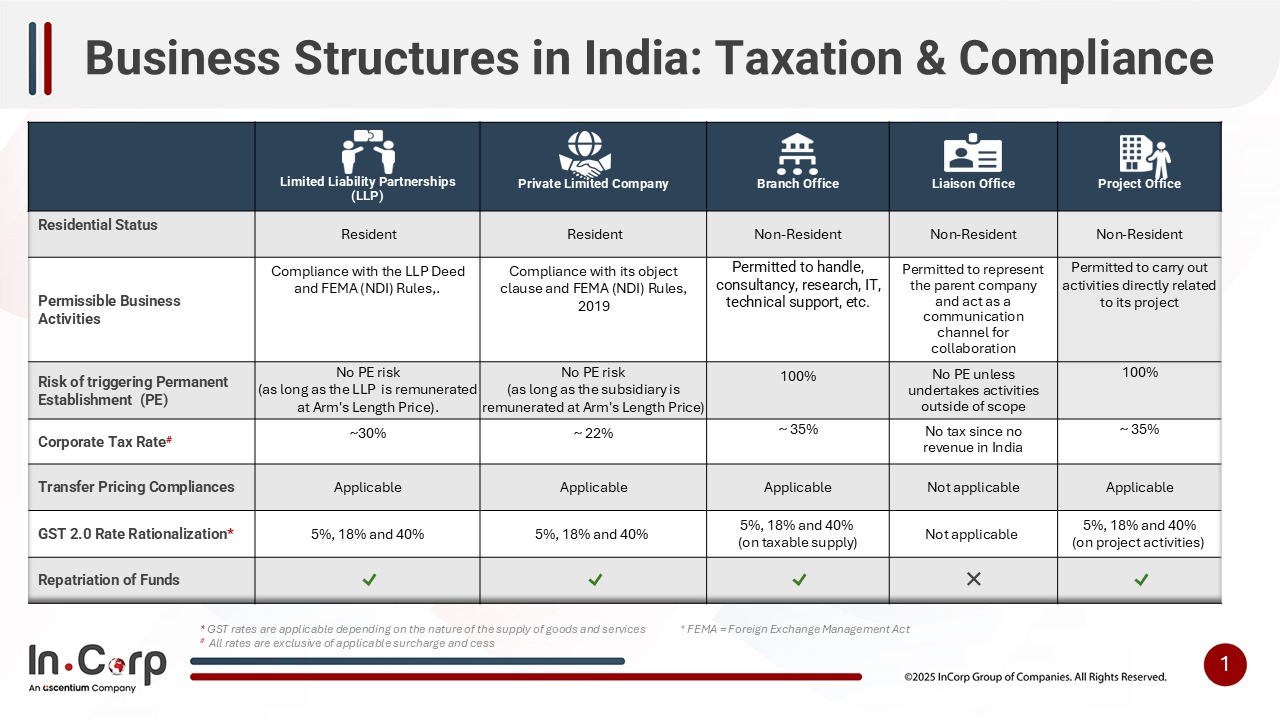
- All rates are exclusive of applicable surcharge and cess
- GST rates are applicable depending on the nature of the supply of goods and services
Post-Incorporation Steps for a Manufacturing Company
Once your manufacturing company has been incorporated, it is imperative to promptly shift focus to the operational and compliance phase to ensure adherence to legal requirements and to capitalise on available incentives. Below is a customised list of essential post-incorporation tasks, with an explanation of their significance for a manufacturing company in India. Open a corporate bank account
Immediately after incorporation, you should open a current bank account in the company’s name, furnishing the Certificate of Incorporation, PAN and other required documents. This ensures you separate business finances from personal funds, which is especially important for audit and compliance purposes.
Register for GST (if applicable)
If your manufacturing company exceeds the prescribed turnover threshold, or if you engage in inter-state supplies or exports of manufacturing services, you must register for the Goods and Services Tax (GST). Once registered you need to issue GST-compliant invoices, maintain records and file periodic returns.
Comply with annual filings, auditors, and statutory records
Under the Companies Act, 2013, your manufacturing company must maintain statutory books (registers of members, directors, charges etc.), prepare audited financial statements, hold board/shareholder meetings, and file returns (e.g., AOC-4, MGT-7) annually with the Ministry of Corporate Affairs. Non-compliance can lead to fines or director disqualification.
Explore government schemes like Startup India initiative for benefits
If your manufacturing company qualifies (e.g., operates in eligible sectors such as electronics, automobiles, textiles, or pharmaceuticals, meets minimum investment and domestic value-addition criteria, and demonstrates incremental production or sales growth), you can apply under the PLI scheme to access financial incentives linked to incremental output, reduced production costs, enhanced global competitiveness, and government support for scaling domestic manufacturing capacity.
Conclusion: Your Roadmap to Incorporation
You now have a clear understanding of the entire journey, from selecting the right business structure to managing post-incorporation compliance, designed specifically for a Wholesale trade company planning to register in India. This step-by-step roadmap highlights the importance of systematic compliance and careful attention to every detail. Use this guide as your foundation, and seek professional assistance whenever necessary to ensure a smooth registration experience. With the right approach, India Company Incorporation remains your trusted partner for business setup consultancy services in India.